Saturday, March 28, 2009
John Calvin -- Missions and Church Planting
Mark Driscoll gives a nice introduction to John Calvin's sustained efforts to train and launch missionaries, and sponsor church planting in the mid-1500's.

Thursday, March 26, 2009
Why Do We Need to Learn Faster?
This popular video is studded with facts about the exponentially fast technological changes we're living in.
Our fundamental problems are spiritual, not technical, political, or economic. But in order to continue to be effective, we need to keep learning faster.
Our fundamental problems are spiritual, not technical, political, or economic. But in order to continue to be effective, we need to keep learning faster.
Leadership is Performance Art
I was intrigued with this concept: Leadership is Performance Art.
By the way, Thayer's book "Leadership: Thinking, Being, Doing" is a rock-your-comfortable-world book. It's not an easy read, either, I'm wading through it in chunks. There's somehere here to offend everyone's usual sensibilities about leadership -- but it's good.
By the way, Thayer's book "Leadership: Thinking, Being, Doing" is a rock-your-comfortable-world book. It's not an easy read, either, I'm wading through it in chunks. There's somehere here to offend everyone's usual sensibilities about leadership -- but it's good.
Vetting Prayers
Apparently the Obama Administration requires pre-approval of prayers used at public events where the President will be speaking.
Don't use the name of Jesus, that could be inflammatory!
I'm disturbed by this trendline.
HT: Gene Veith
Don't use the name of Jesus, that could be inflammatory!
I'm disturbed by this trendline.
HT: Gene Veith
Three Thoughtful Quotes
"The main vice of capitalism is the uneven distribution of prosperity. The main vice of socialism is the even distribution of misery." --former British Prime Minister Sir Winston Churchill (1874-1965)
"There are 10^11 stars in the galaxy. That used to be a huge number. But it's only a hundred billion. It's less than the national deficit! We used to call them astronomical numbers. Now we should call them economical numbers." --American physicist Richard Feynman (1918-1988)
"When small men begin to cast big shadows, it means that the sun is about to set." --Chinese writer Lin Yutang (1895-1976)
HT: Patriot Post
"There are 10^11 stars in the galaxy. That used to be a huge number. But it's only a hundred billion. It's less than the national deficit! We used to call them astronomical numbers. Now we should call them economical numbers." --American physicist Richard Feynman (1918-1988)
"When small men begin to cast big shadows, it means that the sun is about to set." --Chinese writer Lin Yutang (1895-1976)
HT: Patriot Post
Culture Declines, God's Sovereignty
I think one of the reasons for expanded interest in eschatology is that many of us live in times when we perceive the coming end of our predominate culture. Paul could see the evidence of the decline of the Roman empire, I’m sure. Of course in the 1970’s we had a lot of economic and political difficulties, and Hal Lindsey assured us the end was near.
If we pull back and view historical patterns, there are hopeful signs.
For example, in the 1790’s the quite new country of the United States of America was in serious trouble. Flailing economic mess, high alcoholism and suicide and crime rates, major foreign powers poised for assaults – much worse, really, than anything we experience today. But consider how this decade of horrible problems laid the groundwork for the Great Awakening in 1800 and 1801!
Let us remember that God is sovereign, fulfills all His promises, and alone knows the timing of the end. Until then, we look for Christ’s coming, and live as faithful ambassadors, blessing our communities and countries as we have opportunities, and making disciples of all nations, as He commanded.
If we pull back and view historical patterns, there are hopeful signs.
For example, in the 1790’s the quite new country of the United States of America was in serious trouble. Flailing economic mess, high alcoholism and suicide and crime rates, major foreign powers poised for assaults – much worse, really, than anything we experience today. But consider how this decade of horrible problems laid the groundwork for the Great Awakening in 1800 and 1801!
Let us remember that God is sovereign, fulfills all His promises, and alone knows the timing of the end. Until then, we look for Christ’s coming, and live as faithful ambassadors, blessing our communities and countries as we have opportunities, and making disciples of all nations, as He commanded.
Tuesday, March 24, 2009
My Great Books List
After my recent post discussing my reading habits, a number of you asked me for a reading list.
I don't recommend every book I've read to others. And I read widely, across a number of disciplines. But I thought it was worth the time to list out 75 explicitly Christian books which have greatly influenced me.
These are the books that I return to, gladly, again and again, knowing that I can learn still more from them. The authors have been used by God to help disciple me.
Here is the list.
I'll be interested to hear your comments and feedback.
I don't recommend every book I've read to others. And I read widely, across a number of disciplines. But I thought it was worth the time to list out 75 explicitly Christian books which have greatly influenced me.
These are the books that I return to, gladly, again and again, knowing that I can learn still more from them. The authors have been used by God to help disciple me.
Here is the list.
I'll be interested to hear your comments and feedback.
Life Management
Scott Aughtmon, one of the most creative church-gatherers (he doesn't call himself a church planter) I've encountered, gives some helpful advice about life management.
Sober but Encouraging
Hutchins' analysis of the financial problems we face -- how we got here, and the importance of innovation and private capital investment in getting out -- is well worth putting on your reading pile.
Monday, March 23, 2009
How God Helps Us Face Our Fears
Perry Noble has a good post with insights about how fathers -- and God -- help their children face their fears.
Saturday, March 21, 2009
The Question
I’m sure my friend and mentor didn’t understand the explosive power of the bomb he dropped on me.
His simple question transformed the way I have thought about sin, temptation, and the Christian life.
I met weekly with my friend for encouragement and mutual accountability in agreed-upon areas of weakness. For three weeks running I had to confess failings in one particular area. “I hate that I’m saying it,” I said quietly, “but… I did it again.”
“Here comes the lecture,” I thought, knowing I deserved it.
My friend paused, then asked me this simple, profound, and powerful question:
“That’s not consistent with Christ in you, is it?”
In that moment God catalyzed something wonderful in my mind. Following Jesus is not about making my heart and mind better through external “righteousness.” Following Jesus means my thinking, acting, and living should flow out of the glorious reality that I am a new creature in Christ.
“Therefore, if anyone is in Christ, he is a new creation; the old has gone, the new has come!” (2 Corinthians 5:17) The reality of this new creation is the primary source of all wisdom, godliness, and righteous living (see Galatians 6:15).
Use this question to help frame your decisions. When you’re faced with a choice, you can ask “Lord, what’s most consistent with Christ in me?”
Use this question to resist besetting sins. When you are tempted, it helps enormously to ask “Is this consistent with Christ in me?”
Use this question when you are fearful, or weak, to remind yourself of the character of Christ in you. “Is this consistent with Christ in me?”
Let us be grateful people, confident in “Christ in us, the hope of glory.” (Colossians 1:27)
His simple question transformed the way I have thought about sin, temptation, and the Christian life.
I met weekly with my friend for encouragement and mutual accountability in agreed-upon areas of weakness. For three weeks running I had to confess failings in one particular area. “I hate that I’m saying it,” I said quietly, “but… I did it again.”
“Here comes the lecture,” I thought, knowing I deserved it.
My friend paused, then asked me this simple, profound, and powerful question:
“That’s not consistent with Christ in you, is it?”
In that moment God catalyzed something wonderful in my mind. Following Jesus is not about making my heart and mind better through external “righteousness.” Following Jesus means my thinking, acting, and living should flow out of the glorious reality that I am a new creature in Christ.
“Therefore, if anyone is in Christ, he is a new creation; the old has gone, the new has come!” (2 Corinthians 5:17) The reality of this new creation is the primary source of all wisdom, godliness, and righteous living (see Galatians 6:15).
Use this question to help frame your decisions. When you’re faced with a choice, you can ask “Lord, what’s most consistent with Christ in me?”
Use this question to resist besetting sins. When you are tempted, it helps enormously to ask “Is this consistent with Christ in me?”
Use this question when you are fearful, or weak, to remind yourself of the character of Christ in you. “Is this consistent with Christ in me?”
Let us be grateful people, confident in “Christ in us, the hope of glory.” (Colossians 1:27)
Friday, March 20, 2009
Answering Questions about Learning Faster
I've gotten some interesting email about my messages
challenging teachers, pastors, and church leaders to be
better learners.
Let me address some of the questions and statements that
might be of more general interest.
"I have a master's degree from seminary and read a lot.
I'm sure some people on your mailing list could use your
help, but I don't." -- Pastor A.W.
Great learners are simply people who know they have a lot
more to learn, and remain excited about learning. If you
don't think I could help you learn faster and better (with
less stress, too), then you're exactly right. If your mind
is closed to improvement, I won't be able to teach you, any
more than Jesus could open the minds of some of the
Pharisees. May our Lord bless your pastoral ministry.
"Can you help me? I have trouble reading the newspaper
sometimes. I want to be better, so I can be a better
teacher." -- B.P.
The Lord will, I'm sure, bless your ministry in His Name.
I do believe that everyone can see improvements in their
ability to learn and retain useful information for teaching
and pastoral ministry work.
You see, it's not important whether you can read 100 books
in a year. It is important that you get better by learning
to learn faster. If you read 2 or 3 books a year, you can
readily push yourself to read 5 to 10 books (with less
stress, I might add!) and retain the information better.
"Is this just about memorization? I use the Navigator's
method and it works for me." -- S.W.
I actually won't cover memorization explicitly in this
coaching. Enormous feats of memorization are possible (and
indeed have been routine -- young Jewish boys memorized the
Torah). What I'll explain doesn't depend upon memorization
to be successful.
"Does this require special software? I don't have a fancy
computer or any money to buy tools." -- W.A.
A lot of what I'll show you can be done without any special
tools at all. (Our ancestors had less than you do!) I will
tell you about optional software tools that can help, and
nearly all of them are free.
"I'd like to read more, but I don't have time." -- J.J.
If you practice a little bit of what I'll show you, you can
read 2 to 4 times faster. And retain more. I'm completely
serious. Over the remaining years the Lord gives you,
wouldn't you like to be able to read more, remember it
better, and retain the valuable parts longer? This will be
a huge benefit you'll enjoy with just a little bit of effort
on your part.
"Speed reading courses don't work for me." -- A.S.
I'm cynical about speed-reading courses myself. I read an
ad for one course and realized that if their claims were
true, I could read "Gone with the Wind" in 26 minutes.
Bleh.
What I'm going to be teaching you is a lot more than speed
reading. It's about *learning* -- which is not just
reading, listening, or watching, but understanding the
material and making connections in your mind. Faster
reading is possible and desirable, but it's an incomplete
picture of what you need.
"Are you suggesting that the way I learned to study was
wrong? I went good schools." -- D.F.
My observation is that very few adults, even those who have
been to good schools, learned how to learn. They rarely
were encouraged to figure out their personal strengths and
leverage them to the fullest. And far too few people were
encouraged to remain curious throughout their who lives.
I'm less interested in criticizing schools or teachers --
and more interested in helping everyone become a superior
learner. Wherever you are now with your learning skills,
I'm confident you can be much better.
"I prefer to listen to audios and watch videos instead of
reading. Will your approach help me, or is it only about
reading?" -- U.G.
Most of what I will cover applies to any medium -- reading
text, listening to audios, or watching videos.
"Where did you learn what you're going to teach in this
course?" -- A.S.
I've been working on improving my learning skills since I
was in high school. I've searched out many people who
clearly were effective learners and tapped into their ideas
about what helps them. I've studied the neurobiology of the
learning process, as little as we understand it, and read
through many reports of psychological experiments on
comprehension and retention of information. Plus I've
tried many personal experiments to practice and adapt and
improve myself. It's an ongoing process for me.
Until now I have shared my learning with only a handful of
people who have asked for help. Recently it's become plain
to me that the information could help many, many people in
the church.
"I read the Bible and nothing else. Why would I?" -- C.K.
I don't advocate reading other information instead of the
Bible, and I certainly think we should generally be
investing more time with the Word of God than less. But we
belong to the historic community of believers through the
centuries now, and can learn a lot from the writings of
those who have gone before us. And we should also be
students of the best of the world around us, in order to
develop our skills and understanding, and be able to reach
that world effectively with the Gospel. I fervently
believe that all truth is God's truth, and worth studying.
We develop discernment and wisdom as we learn.
So I do think you as a teacher should study and learn from
more information sources than the Bible, and evaluate
everything through the power of the HolySpirit. The
challenge then becomes how to learn effectively and
efficiently from the astounding amount of information
available to us!
Did I cover your concern area? If I didn't, let me know in the comments.
The "Keys to Accelerated Learning" materials is almost
ready. Watch for an announcement soon!
challenging teachers, pastors, and church leaders to be
better learners.
Let me address some of the questions and statements that
might be of more general interest.
"I have a master's degree from seminary and read a lot.
I'm sure some people on your mailing list could use your
help, but I don't." -- Pastor A.W.
Great learners are simply people who know they have a lot
more to learn, and remain excited about learning. If you
don't think I could help you learn faster and better (with
less stress, too), then you're exactly right. If your mind
is closed to improvement, I won't be able to teach you, any
more than Jesus could open the minds of some of the
Pharisees. May our Lord bless your pastoral ministry.
"Can you help me? I have trouble reading the newspaper
sometimes. I want to be better, so I can be a better
teacher." -- B.P.
The Lord will, I'm sure, bless your ministry in His Name.
I do believe that everyone can see improvements in their
ability to learn and retain useful information for teaching
and pastoral ministry work.
You see, it's not important whether you can read 100 books
in a year. It is important that you get better by learning
to learn faster. If you read 2 or 3 books a year, you can
readily push yourself to read 5 to 10 books (with less
stress, I might add!) and retain the information better.
"Is this just about memorization? I use the Navigator's
method and it works for me." -- S.W.
I actually won't cover memorization explicitly in this
coaching. Enormous feats of memorization are possible (and
indeed have been routine -- young Jewish boys memorized the
Torah). What I'll explain doesn't depend upon memorization
to be successful.
"Does this require special software? I don't have a fancy
computer or any money to buy tools." -- W.A.
A lot of what I'll show you can be done without any special
tools at all. (Our ancestors had less than you do!) I will
tell you about optional software tools that can help, and
nearly all of them are free.
"I'd like to read more, but I don't have time." -- J.J.
If you practice a little bit of what I'll show you, you can
read 2 to 4 times faster. And retain more. I'm completely
serious. Over the remaining years the Lord gives you,
wouldn't you like to be able to read more, remember it
better, and retain the valuable parts longer? This will be
a huge benefit you'll enjoy with just a little bit of effort
on your part.
"Speed reading courses don't work for me." -- A.S.
I'm cynical about speed-reading courses myself. I read an
ad for one course and realized that if their claims were
true, I could read "Gone with the Wind" in 26 minutes.
Bleh.
What I'm going to be teaching you is a lot more than speed
reading. It's about *learning* -- which is not just
reading, listening, or watching, but understanding the
material and making connections in your mind. Faster
reading is possible and desirable, but it's an incomplete
picture of what you need.
"Are you suggesting that the way I learned to study was
wrong? I went good schools." -- D.F.
My observation is that very few adults, even those who have
been to good schools, learned how to learn. They rarely
were encouraged to figure out their personal strengths and
leverage them to the fullest. And far too few people were
encouraged to remain curious throughout their who lives.
I'm less interested in criticizing schools or teachers --
and more interested in helping everyone become a superior
learner. Wherever you are now with your learning skills,
I'm confident you can be much better.
"I prefer to listen to audios and watch videos instead of
reading. Will your approach help me, or is it only about
reading?" -- U.G.
Most of what I will cover applies to any medium -- reading
text, listening to audios, or watching videos.
"Where did you learn what you're going to teach in this
course?" -- A.S.
I've been working on improving my learning skills since I
was in high school. I've searched out many people who
clearly were effective learners and tapped into their ideas
about what helps them. I've studied the neurobiology of the
learning process, as little as we understand it, and read
through many reports of psychological experiments on
comprehension and retention of information. Plus I've
tried many personal experiments to practice and adapt and
improve myself. It's an ongoing process for me.
Until now I have shared my learning with only a handful of
people who have asked for help. Recently it's become plain
to me that the information could help many, many people in
the church.
"I read the Bible and nothing else. Why would I?" -- C.K.
I don't advocate reading other information instead of the
Bible, and I certainly think we should generally be
investing more time with the Word of God than less. But we
belong to the historic community of believers through the
centuries now, and can learn a lot from the writings of
those who have gone before us. And we should also be
students of the best of the world around us, in order to
develop our skills and understanding, and be able to reach
that world effectively with the Gospel. I fervently
believe that all truth is God's truth, and worth studying.
We develop discernment and wisdom as we learn.
So I do think you as a teacher should study and learn from
more information sources than the Bible, and evaluate
everything through the power of the HolySpirit. The
challenge then becomes how to learn effectively and
efficiently from the astounding amount of information
available to us!
Did I cover your concern area? If I didn't, let me know in the comments.
The "Keys to Accelerated Learning" materials is almost
ready. Watch for an announcement soon!
Wednesday, March 18, 2009
Learning to Learn Faster -- Overview Lesson Available
I wrote the other day about my concerns that teachers, pastors, and church leaders aren't learning fast enough or well enough. If the people working in the Kingdom of God aren't the best learners, we'll fall far short of our God-given potential.
People routinely far underestimate what they are capable of learning. If you learned 7 facts per second, 24 hours a day, you could go over 200 years before you would run out of neurons to store the information. Our Lord has made you with a practically infinite capability to learn.
You and I will tap only a fraction of our potential, but we should become much better learners than we are today. We should always be striving to improve our capabilities, because the needs of the Kingdom demand us to be our best -- and better every year.
Here's what I'm going to make available soon: Audio lessons coaching you -- yes YOU -- to learn faster, better, and retain what you need from it all. I'm confident that the practical advice will give you an enormous edge.
You'll learn:
* What learning *really* is
* The key elements of your learning mindset
* Practical counsel on all the elements of the learning process: preparation, input, thinking, and review
* Specific tactics to help you read and listen 200-400% faster than you do today. (No typo there -- 2x to 4x faster.)
* My recommended "tool" list
If this interests you, then please sign up here to learn more. (I don't want to burden anyone who isn't particularly interested!)
http://www.teachtochangelives.com/LearnFasterSignUp
When you sign up, you'll get a 15 minute overview lesson that covers all the key ideas at a high level.
The full course materials will have a lot more detail and practical helps, but my hope is that you'll be able to start putting some of these ideas into practice right away.
I'm praying that God will raise up a more effective generation of teachers, pastors, and church leaders, by sharpening their ability to learn.
Again, sign up to get started learn faster:
http://www.teachtochangelives.com/LearnFasterSignUp
People routinely far underestimate what they are capable of learning. If you learned 7 facts per second, 24 hours a day, you could go over 200 years before you would run out of neurons to store the information. Our Lord has made you with a practically infinite capability to learn.
You and I will tap only a fraction of our potential, but we should become much better learners than we are today. We should always be striving to improve our capabilities, because the needs of the Kingdom demand us to be our best -- and better every year.
Here's what I'm going to make available soon: Audio lessons coaching you -- yes YOU -- to learn faster, better, and retain what you need from it all. I'm confident that the practical advice will give you an enormous edge.
You'll learn:
* What learning *really* is
* The key elements of your learning mindset
* Practical counsel on all the elements of the learning process: preparation, input, thinking, and review
* Specific tactics to help you read and listen 200-400% faster than you do today. (No typo there -- 2x to 4x faster.)
* My recommended "tool" list
If this interests you, then please sign up here to learn more. (I don't want to burden anyone who isn't particularly interested!)
http://www.teachtochangelives.com/LearnFasterSignUp
When you sign up, you'll get a 15 minute overview lesson that covers all the key ideas at a high level.
The full course materials will have a lot more detail and practical helps, but my hope is that you'll be able to start putting some of these ideas into practice right away.
I'm praying that God will raise up a more effective generation of teachers, pastors, and church leaders, by sharpening their ability to learn.
Again, sign up to get started learn faster:
http://www.teachtochangelives.com/LearnFasterSignUp
Let the Gospel Grow In Your Life
John Piper exhorts us to never let the Gospel get smaller in our lives. Short, helpful.
Great Resource for Listeners
I tend to favor reading over listening, but there are tremendously good sermons and talks and podcasts available. I love the tagline on the Faith By Hearing blog: "Seize Your Commute." This is an outstanding starting point if you'd like to load up your ipod or car with great material to bless you and your family.
Standing Against the Lie
This transcript of a podcast by Greg Koukl (of Stand to Reason) is a gem. Highly recommended. Let us be found as men who fight against the lie.
"Some of you might be thinking that the enemy is those people who disagree with us. You’d be wrong. You might be thinking the enemy is the devil. Well, he is an enemy. There’s no question about that. But I think the enemy, the focus of our efforts, is what the devil is trying to do to change people’s minds so that they believe a lie rather than the truth. The evil that we are seeking to overturn can be summarized by the words “the lie.”
Paul talks about it in Romans 1:21-25. They believed the lie rather than the truth. People suppressed the truth they should have been following and instead believed a lie. Claiming to be wise, they became fools. Following that in Romans is an explicit statement against homosexuality and lesbianism, and a whole rogue’s gallery of vice listed there at the end of Chapter 1 of Romans. All of these come from believing the lie.
What is the truth that the lie denies? The truth is that God is king and sovereign over all His domain, which is everything and everyone, because He created everything and everyone, and therefore, all is His. The lie says that we are our own. We belong to no one. We are masters of our own fate. We are captains of our own soul. Get out of my way. Don’t cramp my style. And when this lie is believed, what follows is the denial of this central truth that God is king and sovereign. "
Read the whole article, and mark it up. Absorb this one.
"Some of you might be thinking that the enemy is those people who disagree with us. You’d be wrong. You might be thinking the enemy is the devil. Well, he is an enemy. There’s no question about that. But I think the enemy, the focus of our efforts, is what the devil is trying to do to change people’s minds so that they believe a lie rather than the truth. The evil that we are seeking to overturn can be summarized by the words “the lie.”
Paul talks about it in Romans 1:21-25. They believed the lie rather than the truth. People suppressed the truth they should have been following and instead believed a lie. Claiming to be wise, they became fools. Following that in Romans is an explicit statement against homosexuality and lesbianism, and a whole rogue’s gallery of vice listed there at the end of Chapter 1 of Romans. All of these come from believing the lie.
What is the truth that the lie denies? The truth is that God is king and sovereign over all His domain, which is everything and everyone, because He created everything and everyone, and therefore, all is His. The lie says that we are our own. We belong to no one. We are masters of our own fate. We are captains of our own soul. Get out of my way. Don’t cramp my style. And when this lie is believed, what follows is the denial of this central truth that God is king and sovereign. "
Read the whole article, and mark it up. Absorb this one.
Tuesday, March 17, 2009
Follow Me on Twitter
I'm inviting you to follow me on Twitter.
I don't have a wall on Facebook or a MySpace page, and I routinely reject the three invitations I get each week to join the "latest" social networking site. I endure comments from "youngsters" that if I don't Facebook, I don't exist.
But I'm committed to providing regular Twitter updates in addition to the blogs I manage. You'll get to see more about what I'm doing and learning about. It's a free service, too.
Go here if you'd like to follow me on Twitter:
http://www.twitter.com/Glenn_Brooke
I don't have a wall on Facebook or a MySpace page, and I routinely reject the three invitations I get each week to join the "latest" social networking site. I endure comments from "youngsters" that if I don't Facebook, I don't exist.
But I'm committed to providing regular Twitter updates in addition to the blogs I manage. You'll get to see more about what I'm doing and learning about. It's a free service, too.
Go here if you'd like to follow me on Twitter:
http://www.twitter.com/Glenn_Brooke
Political-centric Evangelicals: Where is Jesus?
Michael Spenser riles and provokes with posts like "The Limbaughization of Evangelicals," where he points out that many evangelicals celebrate a political viewpoint (whether right or left) rather than worship Jesus.
Happy St. Patrick's Day
Happy St. Patrick's Day!
If you're looking for a good secular resource on Patrick, start with the wikipedia entry.
If you're looking for a good secular resource on Patrick, start with the wikipedia entry.
Monday, March 16, 2009
We've Got a Lot of Synapses to Work With
I love reading about our brains and how our minds work. Our brain is a whole lot more than "3.5 pounds of blood-soaked sponge," as Vonnegut opined. Mark Batterson helps us understand theastounding number of sensors and synapses we have.
Truly, we are fearfully and wonderfully made!
Sunday, March 15, 2009
Learning Faster -- The Great Need
A significant challenge for Bible teachers and church leaders today is keeping up with what's going on.
Of course, just keeping up today isn't good enough.
In addition to regular, deep time in the Word of God, teachers, pastors, and leaders need to be students of life.
I believe one of the reasons why the Church is not leading the way today as it could and should is that the leaders are poor learners.
If you study who takes the lead in the culture, in businesses, in civic organizations, and even in governments, there is a strong correlation with the people who are the fastest and best learners.
Now I strongly believe that Christians should be the best learners and thinkers on the planet -- we have the Mind of Christ! But it is often not so.
My own reputation is that I'm a terrific learner. In addition to my full-time job (not in a church), family and church leadership responsibilities, and running Brooke Associates, I'm constantly in learning mode.
For example, I will read through the whole Bible 4 times this year, as I did last year. I read 131 books last year and plan to finish over 110 this year. I'm consistently reading sixteen magazines and trade publications, plus following the text, audio, and video content on 72 blogs. My friends, fellow church leaders, and students will tell you that I can remember a huge amount. "Being around you, Glenn, is like sipping from a fire hose of knowledge and insight," says one.
Am I superman, or the bionic man? No. Do I sleep and exercise and eat? Yes. Do I have some super-high IQ that lets me do this? I'm a reasonably smart guy, but know plenty of people much smarter than me. Are these extraordinary, superhuman accomplishments? Absolutely not! They are well within the range of most adults.
What sets great teachers, pastors, and leaders apart on the learning scale is
* they know what they need to learn, and why
* they understand what learning really is, and have mastered the practices of learning
* they apply what they learn (because the point of learning is not knowing, it's doing)
In a few days I'll write again about this issue, because I think it's extremely important.
Saturday, March 14, 2009
Handling Nuclear Waste
William Tucker's article "There's No Such Thing as Nuclear Waste" is probably mis-titled, but makes effective points about the feasibility of storing what's left over from rods used in nuclear power plants.
"Ninety-five percent of a spent fuel rod is plain old U-238, the nonfissionable variety that exists in granite tabletops, stone buildings and the coal burned in coal plants to generate electricity. Uranium-238 is 1% of the earth's crust. It could be put right back in the ground where it came from.
Of the remaining 5% of a rod, one-fifth is fissionable U-235 -- which can be recycled as fuel. Another one-fifth is plutonium, also recyclable as fuel. Much of the remaining three-fifths has important uses as medical and industrial isotopes. Forty percent of all medical procedures in this country now involve some form of radioactive isotope, and nuclear medicine is a $4 billion business. Unfortunately, we must import all our tracer material from Canada, because all of our isotopes have been headed for Yucca Mountain.
What remains after all this material has been extracted from spent fuel rods are some isotopes for which no important uses have yet been found, but which can be stored for future retrieval. France, which completely reprocesses its recyclable material, stores all the unused remains -- from 30 years of generating 75% of its electricity from nuclear energy -- beneath the floor of a single room at La Hague."
"Ninety-five percent of a spent fuel rod is plain old U-238, the nonfissionable variety that exists in granite tabletops, stone buildings and the coal burned in coal plants to generate electricity. Uranium-238 is 1% of the earth's crust. It could be put right back in the ground where it came from.
Of the remaining 5% of a rod, one-fifth is fissionable U-235 -- which can be recycled as fuel. Another one-fifth is plutonium, also recyclable as fuel. Much of the remaining three-fifths has important uses as medical and industrial isotopes. Forty percent of all medical procedures in this country now involve some form of radioactive isotope, and nuclear medicine is a $4 billion business. Unfortunately, we must import all our tracer material from Canada, because all of our isotopes have been headed for Yucca Mountain.
What remains after all this material has been extracted from spent fuel rods are some isotopes for which no important uses have yet been found, but which can be stored for future retrieval. France, which completely reprocesses its recyclable material, stores all the unused remains -- from 30 years of generating 75% of its electricity from nuclear energy -- beneath the floor of a single room at La Hague."
Never Understimate a Microtrend
"In today's mass societies, it takes only 1 percent of people making a dedicated choice -- contrary to the mainstream's choice -- to create a movement that can change the world."
(from the book, Microtrends: The Small Forces Behind Tomorrow's Big Changes)
HT: Matt Perman
(from the book, Microtrends: The Small Forces Behind Tomorrow's Big Changes)
HT: Matt Perman
Friday, March 13, 2009
How Prayer Changed New York
I have a good friend who lived in New York city years back, and so I sent him this interesting analysis of the changes in the city.
I really enjoyed his response:
-=-=-=-=-=-=-=-=-=-=-=-=-
Glenn,
Thanks for the article. I lived in NYC in the late 80s and early 90s. He is right; it was a very bad place. Crack vials piled up along gutters like leaves in autumn. My neighborhood had the highest homicide rate in the city; it was a fearful place.
Olasky left out what I believe is the single biggest reason that NYC changed...prayer. In 1989, the city had Calvary Baptist (anchor of evangelicals) and Gordon MacDonald and Tim Keller. Those churches began praying for the city. [My wife and I] would get up early on Friday morning and travel to mid-town to a small prayer meeting of leaders at Redeemer where we experienced the most delicious group prayer times that I have ever had. We prayed for the usual Aunt with a bad hip and friend with a dying dog, but mostly we prayed that God's kingdom would be realized in the city; we affirmed that God loved NYC and wanted to change it; we implored Him to do so. We prayed for social justice and for individual hearts; we prayed for revival in the Jonathan Edwards sense of word. We didn't pray for church programs; we prayed for the chaotic outpouring of the Holy Spirit. As Harvey Conn says, "prayer is rebellion against the status quo" that is what we did.
-=-=-=-=-=-=-=-=-=-=-=-=-
This helps get me fired up to pray for revival in my area!
I really enjoyed his response:
-=-=-=-=-=-=-=-=-=-=-=-=-
Glenn,
Thanks for the article. I lived in NYC in the late 80s and early 90s. He is right; it was a very bad place. Crack vials piled up along gutters like leaves in autumn. My neighborhood had the highest homicide rate in the city; it was a fearful place.
Olasky left out what I believe is the single biggest reason that NYC changed...prayer. In 1989, the city had Calvary Baptist (anchor of evangelicals) and Gordon MacDonald and Tim Keller. Those churches began praying for the city. [My wife and I] would get up early on Friday morning and travel to mid-town to a small prayer meeting of leaders at Redeemer where we experienced the most delicious group prayer times that I have ever had. We prayed for the usual Aunt with a bad hip and friend with a dying dog, but mostly we prayed that God's kingdom would be realized in the city; we affirmed that God loved NYC and wanted to change it; we implored Him to do so. We prayed for social justice and for individual hearts; we prayed for revival in the Jonathan Edwards sense of word. We didn't pray for church programs; we prayed for the chaotic outpouring of the Holy Spirit. As Harvey Conn says, "prayer is rebellion against the status quo" that is what we did.
-=-=-=-=-=-=-=-=-=-=-=-=-
This helps get me fired up to pray for revival in my area!
To Whom Has God “Chained” You?
You probably know that Paul wrote a number of New Testament epistles to the churches while he was imprisoned in Rome. You may not know that he was chained to a rotating schedule of Roman soldiers, day and night, the entire time.
And pray for us, too, that God may open a door for our message, so that we may proclaim the mystery of Christ, for which I am in chains. Pray that I may proclaim it clearly, as I should. Be wise in the way you act toward outsiders; make the most of every opportunity. Let your conversation be always full of grace, seasoned with salt, so that you may know how to answer everyone. (Colossians 4:3-6)
Imagine what it was like to be one of the Roman soldiers chained to Paul. Each man would have seen Paul visit with others, encouraging and challenging them. These soldiers were present while Paul prayed and interceded for the new Christian churches, and watched him write out the letters to the Galatians, Philippians, Ephesians, and Colossians. Each one would have heard the story of Jesus Christ, crucified as a their sins, raised from the dead, and Lord of Lords.
They didn’t have any choice but to hear and see, because they were chained to God’s man for hours every day. That’s why Paul asked the Colossians and Ephesians to pray for him, so that he would proclaim the Gospel clearly.
We can only speculate how God may have used this influence on these guards for good, through many generations. How many were gloriously converted? How many family members and fellow soldiers heard about Jesus this way – and about living an abundant life of love in the Holy Spirit?
I’m looking forward to hearing more of these stories when we get to heaven.
But what about your situation? Are there people who are chained to you?
Oh, I don’t mean chains of iron. I’m talking about forced relationships that you didn’t happily “volunteer” for. (I doubt Paul volunteered to be a prisoner in Rome for years.) Perhaps you have neighbors, co-workers, even extended family relationships that strain you. You don’t naturally gravitate to these people because you want to spend more time with them, but God in His sovereignty has set up the arrangement so you must be with them.
Now you can fight and resist and be resentful (though it won’t help.) Or you can recognize that God has arranged circumstances so that they come into His sphere of influence through you! You are His ambassador in “chains,” my friend!
Let us follow Paul’s example and pray that we will be good ambassadors for Jesus, especially in these situations:
“Pray also for me, that whenever I open my mouth, words may be given me so that I will fearlessly make known the mystery of the gospel, for which I am an ambassador in chains. Pray that I may declare it fearlessly, as I should.” (Ephesians 6:19-20)
In God’s grace, we look forward to future days when we see how God has used us to influence many, many people – even those He had to chain to us to arrange for the Gospel to go forward.
And pray for us, too, that God may open a door for our message, so that we may proclaim the mystery of Christ, for which I am in chains. Pray that I may proclaim it clearly, as I should. Be wise in the way you act toward outsiders; make the most of every opportunity. Let your conversation be always full of grace, seasoned with salt, so that you may know how to answer everyone. (Colossians 4:3-6)
Imagine what it was like to be one of the Roman soldiers chained to Paul. Each man would have seen Paul visit with others, encouraging and challenging them. These soldiers were present while Paul prayed and interceded for the new Christian churches, and watched him write out the letters to the Galatians, Philippians, Ephesians, and Colossians. Each one would have heard the story of Jesus Christ, crucified as a their sins, raised from the dead, and Lord of Lords.
They didn’t have any choice but to hear and see, because they were chained to God’s man for hours every day. That’s why Paul asked the Colossians and Ephesians to pray for him, so that he would proclaim the Gospel clearly.
We can only speculate how God may have used this influence on these guards for good, through many generations. How many were gloriously converted? How many family members and fellow soldiers heard about Jesus this way – and about living an abundant life of love in the Holy Spirit?
I’m looking forward to hearing more of these stories when we get to heaven.
But what about your situation? Are there people who are chained to you?
Oh, I don’t mean chains of iron. I’m talking about forced relationships that you didn’t happily “volunteer” for. (I doubt Paul volunteered to be a prisoner in Rome for years.) Perhaps you have neighbors, co-workers, even extended family relationships that strain you. You don’t naturally gravitate to these people because you want to spend more time with them, but God in His sovereignty has set up the arrangement so you must be with them.
Now you can fight and resist and be resentful (though it won’t help.) Or you can recognize that God has arranged circumstances so that they come into His sphere of influence through you! You are His ambassador in “chains,” my friend!
Let us follow Paul’s example and pray that we will be good ambassadors for Jesus, especially in these situations:
“Pray also for me, that whenever I open my mouth, words may be given me so that I will fearlessly make known the mystery of the gospel, for which I am an ambassador in chains. Pray that I may declare it fearlessly, as I should.” (Ephesians 6:19-20)
In God’s grace, we look forward to future days when we see how God has used us to influence many, many people – even those He had to chain to us to arrange for the Gospel to go forward.
Thursday, March 12, 2009
Good Response to "I don't like organized religion"
From Tullian Tchividjian, about inviting a Starbucks barista to church:
She responded in typical postmodern fashion, saying "I'm into spirituality, but I'm not really into organized religion." Brandon, who has a wonderfully quick wit, replied, "Don't worry, we're really not that organized."
She responded in typical postmodern fashion, saying "I'm into spirituality, but I'm not really into organized religion." Brandon, who has a wonderfully quick wit, replied, "Don't worry, we're really not that organized."
Don't Let Someone Use This Debating Tactic On You
Amy Hall provides an excellent guide to countering a common debating tactic, seen fairly often in statements about embryonic stem cells, same-sex marriage, tax rates, etc. (It's not limited to any political party.)
Busyness Is Not...
I really enjoyed the way C.J. Mahaney describes the problem with busyness:
"... busyness is no sign of diligence, faithfulness, or fruitfulness. And that is because busyness does not indicate that we are devoting ourselves to the most important things. We can become busy with everything under the sun except fulfilling the roles God has assigned for us. And no matter how busy I appear, if I am neglecting one of my primary roles, I am a procrastinator, spinning in unproductive circles."
"... busyness is no sign of diligence, faithfulness, or fruitfulness. And that is because busyness does not indicate that we are devoting ourselves to the most important things. We can become busy with everything under the sun except fulfilling the roles God has assigned for us. And no matter how busy I appear, if I am neglecting one of my primary roles, I am a procrastinator, spinning in unproductive circles."
Wednesday, March 11, 2009
What's the Opportunity Here?
An important question that we need to ask God often as we follow Jesus each day is "What is the opportunity here?"
It might an opportunity to renew our minds.
Praise God.
Serve someone.
Take deep breaths and reorient our hearts to Christ.
Endure.
Surrender our puny plans.
Receive gifts from others.
Encourage others and intercede for them.
Be joyful.
Laugh or cry with others.
Experience the flow of God's compassion towards others.
Kneel in awe before the Lord of Lords.
I'm sure this list is not exhaustive. But I'm sure we always have opportunities.
It might an opportunity to renew our minds.
Praise God.
Serve someone.
Take deep breaths and reorient our hearts to Christ.
Endure.
Surrender our puny plans.
Receive gifts from others.
Encourage others and intercede for them.
Be joyful.
Laugh or cry with others.
Experience the flow of God's compassion towards others.
Kneel in awe before the Lord of Lords.
I'm sure this list is not exhaustive. But I'm sure we always have opportunities.
Tuesday, March 10, 2009
US Unemployment by County
The NY Times has an interesting map of US unemployment by county. Note the variability! Keep this in mind as you read accounts in the media. Reporting averages and totals is not the whole story.
I still believe that the great enemies of Christians now in the US are doubt and fear. Yes, there are alway uncertainties. We have a great God, and fear of anything other than our Lord is optional.
HT: GeoChristian
I still believe that the great enemies of Christians now in the US are doubt and fear. Yes, there are alway uncertainties. We have a great God, and fear of anything other than our Lord is optional.
HT: GeoChristian
Saturday, March 07, 2009
Helpful Analysis of the Auto Industry
Joseph White's analysis of the US auto industry, "How Detroit Automakers Went From Kings of the Road to Roadkill," is an easy and informative read.
He identifies 5 factors that have shaped their course over the last 30 years:
"First, Detroit underestimated the competition—in more ways than one.
Second, GM mismanaged its relationship with the United Auto Workers, and the UAW in its turn did nothing to encourage GM (or Ford or Chrysler) to defuse the demographic time bomb that has now blown up their collective future.
Third, GM, Ford, and Chrysler handled failure better than success. When they made money, they tended to squander it on ill-conceived diversification schemes. It was when they were in trouble that they often did their most innovative work—the first minivans at Chrysler, the first Ford Taurus, and more recently the Chevy Volt were ideas born out of crisis.
Fourth, GM (and Ford and Chrysler) relied too heavily on a few, gas-hungry truck and SUV lines for all their profits-plus the money they needed to cover losses on many of their car lines. They did this for a good reason: When gas was cheap, big gas-guzzling trucks were exactly what their customers wanted—until they were not.
Fifth, GM refused to accept that to survive it could not remain what it was in the 1950s and 1960s—with multiple brands and a dominant market share. Instead, it used short-term strategies such as zero percent financing to avoid reckoning with the consequences of globalization and its own mistakes. "
The whole article belongs in your reading pile. After all, if you're a US citizen, you're part owner now of some of the companies.
He identifies 5 factors that have shaped their course over the last 30 years:
"First, Detroit underestimated the competition—in more ways than one.
Second, GM mismanaged its relationship with the United Auto Workers, and the UAW in its turn did nothing to encourage GM (or Ford or Chrysler) to defuse the demographic time bomb that has now blown up their collective future.
Third, GM, Ford, and Chrysler handled failure better than success. When they made money, they tended to squander it on ill-conceived diversification schemes. It was when they were in trouble that they often did their most innovative work—the first minivans at Chrysler, the first Ford Taurus, and more recently the Chevy Volt were ideas born out of crisis.
Fourth, GM (and Ford and Chrysler) relied too heavily on a few, gas-hungry truck and SUV lines for all their profits-plus the money they needed to cover losses on many of their car lines. They did this for a good reason: When gas was cheap, big gas-guzzling trucks were exactly what their customers wanted—until they were not.
Fifth, GM refused to accept that to survive it could not remain what it was in the 1950s and 1960s—with multiple brands and a dominant market share. Instead, it used short-term strategies such as zero percent financing to avoid reckoning with the consequences of globalization and its own mistakes. "
The whole article belongs in your reading pile. After all, if you're a US citizen, you're part owner now of some of the companies.
Thursday, March 05, 2009
Wednesday, March 04, 2009
The Credit Crisis -- explained
My friend Todd Smith at TenTalentsClub.com referred me to this excellent short video explaining the credit crisis. This could be useful for sharing with your family, and starting a discussion.
Tuesday, March 03, 2009
ESV Study Bible -- completely free in March!
A real treat: the ESV Study Bible online version is completely free in March.
I urge you to take a look at this if you have not already. I've been enjoying the ESV Study Bible for several months.
You can see my video reviews of this terrific study Bible here and here.
I urge you to take a look at this if you have not already. I've been enjoying the ESV Study Bible for several months.
You can see my video reviews of this terrific study Bible here and here.
Lint Mystery "Solved"
Humor for the day: the mystery of belly button lint has been "solved."
When I was about 8 or 9 I received a gag gift at Christmas : a "jeweled" belly button brush, with complete instructions on how to use it. The problem was, I didn't understand that it was a gag gift, so I was annoyed when the givers wanted it back. (My relatives recycled gag gifts over and over.)
When I was about 8 or 9 I received a gag gift at Christmas : a "jeweled" belly button brush, with complete instructions on how to use it. The problem was, I didn't understand that it was a gag gift, so I was annoyed when the givers wanted it back. (My relatives recycled gag gifts over and over.)
Monday, March 02, 2009
Penn Is Given a Bible
This is an intriguing story from Penn (of magicians Penn and Teller fame). How does this athiest respond to the gift of a Bible from an audience member?
Sunday, March 01, 2009
Holy Ambition: book recommendation
I recommend Chip Ingram's book Holy Ambition: What it takes to make a difference for God for your reading list.
He uses Nehemiah's story (excellent exegisis of the text) to walk through six steps for leading:
1. developing a dislocated heart
2. experiencing a broken spirit
3. practicing a radical faith
4. creating a strategic plan
5. exercising a personal commitment
6. growing a couragous soul
Excellent for men and leaders seeking to follow God's direction.
He uses Nehemiah's story (excellent exegisis of the text) to walk through six steps for leading:
1. developing a dislocated heart
2. experiencing a broken spirit
3. practicing a radical faith
4. creating a strategic plan
5. exercising a personal commitment
6. growing a couragous soul
Excellent for men and leaders seeking to follow God's direction.
Saturday, February 28, 2009
Role of Men sermons -- must reads
Pastor Matt Chandler has three sermons I heartily recommend to you, guys. They're on the role of men.
Go here, look down the page for these three sermons:
8.12.07
Defining Masculinity
The Role of Men (Part 1)
Matt Chandler
8.19.07
Men as Husbands
The Role of Men (Part 2)
Matt Chandler
8.26.07
Men as Fathers
The Role of Men (Part 3)
Matt Chandler
Both the audio and transcripts (hooray for we readers!) are available there.
Biblical, insightful, challenging, encouraging, funny, and strong.
P.S. I know there are some wives reading this blog, so make sure your man reads these.
Go here, look down the page for these three sermons:
8.12.07
Defining Masculinity
The Role of Men (Part 1)
Matt Chandler
8.19.07
Men as Husbands
The Role of Men (Part 2)
Matt Chandler
8.26.07
Men as Fathers
The Role of Men (Part 3)
Matt Chandler
Both the audio and transcripts (hooray for we readers!) are available there.
Biblical, insightful, challenging, encouraging, funny, and strong.
P.S. I know there are some wives reading this blog, so make sure your man reads these.
Proposed US Budget -- Concerns
President Obama's budget proposal, heading to Congress now, is generating a lot of concerns.
Gene Veith compiles some information here, for example, tallying near a trillion dollars in additional taxes over 10 years.
I'm not a fan of the proposed cap and trade strategy around carbon emissions, because I believe people grossly underestimate the economic drag on businesses and consumers, and it creates a huge "here's a new revenue stream we can manipulate" temptation for Congress.
Given the extra tax pressures on fossil fuel-based industries, I think we can assume there will be higher gas prices. Some have proposed that this is designed to make alternative fuels and electricity sources more cost effective. As we saw in 2008, higher gas prices lead quickly to higher prices for many products.
In general, business taxes will increase. Capital gains taxes will increase.
I realize we've had progressive taxation laws for decades, but this proposal appears to be accelerating the effect. Eliminating the itemized deduction for individuals earning more than $250,000 seems like class warfare. If you want to help homeowners and the construction industry, why eliminate the deduction for mortgage interest, at any income level?
And the direction appears to be pushing people to rely upon Government services rather than charities. There are mixed stories out there about eliminating charitable deductions. Giving by Christians should not be influenced only by tax policies, but it will be. And please show me examples of government run services that are superior to private services doing the same work.
I have to wonder how all this squares with consistent promises that if you make less than $250,000 your taxes won't be raised a penny.
I haven' t read through the original proposal. I have tried to look at a variety of news sources to get past biased viewpoints to something closer to facts. Some of the tax law changes are scheduled to take effect in 2010, 2011, or later -- under the presumption that the economy will improve, and there will be more rich people again to tax? Keep in mind, too, that this will not emerge from Congress without some changes. But the general directions are concerning.
Gene Veith compiles some information here, for example, tallying near a trillion dollars in additional taxes over 10 years.
I'm not a fan of the proposed cap and trade strategy around carbon emissions, because I believe people grossly underestimate the economic drag on businesses and consumers, and it creates a huge "here's a new revenue stream we can manipulate" temptation for Congress.
Given the extra tax pressures on fossil fuel-based industries, I think we can assume there will be higher gas prices. Some have proposed that this is designed to make alternative fuels and electricity sources more cost effective. As we saw in 2008, higher gas prices lead quickly to higher prices for many products.
In general, business taxes will increase. Capital gains taxes will increase.
I realize we've had progressive taxation laws for decades, but this proposal appears to be accelerating the effect. Eliminating the itemized deduction for individuals earning more than $250,000 seems like class warfare. If you want to help homeowners and the construction industry, why eliminate the deduction for mortgage interest, at any income level?
And the direction appears to be pushing people to rely upon Government services rather than charities. There are mixed stories out there about eliminating charitable deductions. Giving by Christians should not be influenced only by tax policies, but it will be. And please show me examples of government run services that are superior to private services doing the same work.
I have to wonder how all this squares with consistent promises that if you make less than $250,000 your taxes won't be raised a penny.
I haven' t read through the original proposal. I have tried to look at a variety of news sources to get past biased viewpoints to something closer to facts. Some of the tax law changes are scheduled to take effect in 2010, 2011, or later -- under the presumption that the economy will improve, and there will be more rich people again to tax? Keep in mind, too, that this will not emerge from Congress without some changes. But the general directions are concerning.
Friday, February 27, 2009
Not "Debt is Dumb," But Christ!
Matt Chandler makes some great points here -- points I think men as leaders need to grasp about communicating well (even if you're not preaching).
Thursday, February 26, 2009
Sacred Reminder
The programs aren’t sacred.
The methods aren’t sacred.
The ministries aren’t sacred.
The service times aren’t sacred.
The communication style isn’t sacred.
The committees aren’t sacred.
The bylaws aren’t sacred.
The denomination isn’t sacred.
The style of music isn’t sacred.
The color of the carpet isn’t sacred.
The font that used in the bulletin isn’t sacred.
The only thing that’s sacred is the mission of Jesus.
Sometimes we just need to be reminded…
(From Scott Hodge)
Wednesday, February 25, 2009
Procrastination
Procrastination is a weakness for most of us. We're so skilled at rationalization that we paint procrastination with the colors of virtue!
Check out this advice on overcoming procrastination, and be more productive with your energy and time.
Check out this advice on overcoming procrastination, and be more productive with your energy and time.
Our True Enemies Now
These are days when we need mental toughness.
With the drumbeat of disappointing news about the world economy, political situations, continuing struggles everywhere, people are increasingly discouraged and distracted.
Remember that our focus must be on Jesus Christ.
Remember that God is always at work, and will never leave us or forsake us.
Our true enemies now are doubt and fear. Be bold, be gentle -- confident in Christ, and unafraid. Renew these qualities in yourself today, and influence others to do the same.
With the drumbeat of disappointing news about the world economy, political situations, continuing struggles everywhere, people are increasingly discouraged and distracted.
Remember that our focus must be on Jesus Christ.
Remember that God is always at work, and will never leave us or forsake us.
Our true enemies now are doubt and fear. Be bold, be gentle -- confident in Christ, and unafraid. Renew these qualities in yourself today, and influence others to do the same.
Collecting Wisdom About Leadership
You -- yes, you -- are called to leadership roles. You can choose to abdicate, but you cannot outsource leadership roles.
For years now I've read books systematically, aiming for 2 books per week in secular areas of business (including leadership). I believe leaders are readers. In 2008 I read through all the books in the Personal MBA Reading List, and benefited enormously.
But in the past three years I have found the best material has been available on the blogs of skilled leaders with a heart to share what they have learned. The information content is dense, focused, highly valuable. It's consumable, memorable, and easily shared with others.
I was delighted to learn yesterday that the Exponential Network has compiled the best-of-the-best blog posts on leadership into a free ebook. They have many of my favorite bloggers (Batterson, Noble, Godin) and some new to me (Goeschal). What a terrific way to help the continuing education and encouragement of leaders!
This is 281 pages of gold, men. No charge. Get it, and read with a pen in hand.
For years now I've read books systematically, aiming for 2 books per week in secular areas of business (including leadership). I believe leaders are readers. In 2008 I read through all the books in the Personal MBA Reading List, and benefited enormously.
But in the past three years I have found the best material has been available on the blogs of skilled leaders with a heart to share what they have learned. The information content is dense, focused, highly valuable. It's consumable, memorable, and easily shared with others.
I was delighted to learn yesterday that the Exponential Network has compiled the best-of-the-best blog posts on leadership into a free ebook. They have many of my favorite bloggers (Batterson, Noble, Godin) and some new to me (Goeschal). What a terrific way to help the continuing education and encouragement of leaders!
This is 281 pages of gold, men. No charge. Get it, and read with a pen in hand.
How to Nudge the World
"Words are sacred. They deserve respect. If you get the right ones in the right order, you can nudge the world a little..." — Tom Stoppard
Source: http://www.goodreads.com/author/quotes/293.Tom_Stoppard
Source: http://www.goodreads.com/author/quotes/293.Tom_Stoppard
Tuesday, February 24, 2009
Prayer: Not Legalism, but Duty
John Piper gives us helpful instruction about the importance of prayer. This is from a sermon, but you could build a greatfamily devotion around this:
-=-=-=-=-=-=-=-=-=-=-=-=-=-=-
But the hard truth is that most Christians don’t pray very much. They pray at meals—unless they’re still stuck in the adolescent stage of calling good habits legalism. They whisper prayers before tough meetings. They say something brief as they crawl into bed. But very few set aside set times to pray alone—and fewer still think it is worth it to meet with others to pray. And we wonder why our faith is weak. And our hope is feeble. And our passion for Christ is small.
The Duty of Prayer
And meanwhile the devil is whispering all over this room: “The pastor is getting legalistic now. He’s starting to use guilt now. He’s getting out the law now.” To which I say, “To hell with the devil and all of his destructive lies. Be free!” Is it true that intentional, regular, disciplined, earnest, Christ-dependent, God-glorifying, joyful prayer is a duty? Do I go to pray with many of you on Tuesday at 6:30 a.m., and Wednesday at 5:45 p.m., and Friday at 6:30 a.m., and Saturday at 4:45 p.m., and Sunday at 8:15 a.m. out of duty? Is it a discipline? You can call it that. It’s a duty the way it’s the duty of a scuba diver to put on his air tank before he goes underwater. It’s a duty the way pilots listen to air traffic controllers. It’s a duty the way soldiers in combat clean their rifles and load their guns. It’s a duty the way hungry people eat food. It’s a duty the way thirsty people drink water. It’s a duty the way a deaf man puts in his hearing aid. It’s a duty the way a diabetic takes his insulin. It’s a duty the way Pooh Bear looks for honey. It’s a duty the way pirates look for gold.
-=-=-=-=-=-=-=-=-=-=-=-=-=-=-
-=-=-=-=-=-=-=-=-=-=-=-=-=-=-
But the hard truth is that most Christians don’t pray very much. They pray at meals—unless they’re still stuck in the adolescent stage of calling good habits legalism. They whisper prayers before tough meetings. They say something brief as they crawl into bed. But very few set aside set times to pray alone—and fewer still think it is worth it to meet with others to pray. And we wonder why our faith is weak. And our hope is feeble. And our passion for Christ is small.
The Duty of Prayer
And meanwhile the devil is whispering all over this room: “The pastor is getting legalistic now. He’s starting to use guilt now. He’s getting out the law now.” To which I say, “To hell with the devil and all of his destructive lies. Be free!” Is it true that intentional, regular, disciplined, earnest, Christ-dependent, God-glorifying, joyful prayer is a duty? Do I go to pray with many of you on Tuesday at 6:30 a.m., and Wednesday at 5:45 p.m., and Friday at 6:30 a.m., and Saturday at 4:45 p.m., and Sunday at 8:15 a.m. out of duty? Is it a discipline? You can call it that. It’s a duty the way it’s the duty of a scuba diver to put on his air tank before he goes underwater. It’s a duty the way pilots listen to air traffic controllers. It’s a duty the way soldiers in combat clean their rifles and load their guns. It’s a duty the way hungry people eat food. It’s a duty the way thirsty people drink water. It’s a duty the way a deaf man puts in his hearing aid. It’s a duty the way a diabetic takes his insulin. It’s a duty the way Pooh Bear looks for honey. It’s a duty the way pirates look for gold.
-=-=-=-=-=-=-=-=-=-=-=-=-=-=-
Gratitude Over Technological Progress
Lewis C.K. visits with Conan O'Brian and using humor effectively, points out a curious fact about human nature: we're not very grateful for technological progress.
What can you and I do today to exercise our gratitude muscles?
What can you and I do today to exercise our gratitude muscles?
Monday, February 23, 2009
Hollow and Deceptive Philosophies
Colossians 2:8 gives us a strong command ("See to it") to guard ourselves against worldviews and thinking patterns not grounded in Jesus Christ:
"See to it that no one takes you captive through hollow and deceptive philosophy, which depends on human tradition and the basic principles of this world rather than on Christ."
There is a lot of good advice and counsel available in this world. There are also many false teachers who are skilled at persuasive rhetoric.
Here is our guide, then: If the instruction does not have Christ at the center, then it as best hollow, and may well be deceptive.
Looking at financial advice for what to do with your 401K, or counsel for guiding your teenager through difficult years, or instruction about pursuing additional education? Prayerfully ask if Christ is at the center. If not, it may be still be useful, but it is hollow.
"See to it that no one takes you captive through hollow and deceptive philosophy, which depends on human tradition and the basic principles of this world rather than on Christ."
There is a lot of good advice and counsel available in this world. There are also many false teachers who are skilled at persuasive rhetoric.
Here is our guide, then: If the instruction does not have Christ at the center, then it as best hollow, and may well be deceptive.
Looking at financial advice for what to do with your 401K, or counsel for guiding your teenager through difficult years, or instruction about pursuing additional education? Prayerfully ask if Christ is at the center. If not, it may be still be useful, but it is hollow.
Be Done with Opinion Polls
I'm done with opinion polls. I can hardly believe how prevalent they have become in our news media; they're frequently cited now in newspapers, radio, and TV news.
I encourage you to be done with them, too.
Here's why: paying attention to opinion polls fosters a greater willingness to let your convictions be established or changed by what other people say and think. (Actually, more dangerous than that -- what is reported that other people think and say.)
We need to be men of God, focusing our attention on God, and drawing our beliefs and convictions from God.
I encourage you to be done with them, too.
Here's why: paying attention to opinion polls fosters a greater willingness to let your convictions be established or changed by what other people say and think. (Actually, more dangerous than that -- what is reported that other people think and say.)
We need to be men of God, focusing our attention on God, and drawing our beliefs and convictions from God.
Sunday, February 22, 2009
Fighting the Temptation to Be Lazy
I love Perry Noble's counsel here for leaders (applies to leadership in the home as well as church and community):
“Do your best to present yourself to God as one approved, A WORKMAN…”
One of the biggest temptations for a leader is to become lazy and the begin to expect God to do what HE has clearly commanded the leader to do.
It is my responsibility as a leader to make sure I am prepared to preach God’s Word every Sunday.
It is my responsibility as a leader to make sure that I am growing in my faith and in my leadership abilities.
It is my responsibility as a leader to work hard, to put time, effort and energy into the things God has called me to lead.
One of the most dangerous things a leader can do is put their leadership on cruise control. God didn’t call us to cruise…He called us to create…and that ONLY comes through us being willing to roll up our sleeves and WORK HARD.
“Do your best to present yourself to God as one approved, A WORKMAN…”
One of the biggest temptations for a leader is to become lazy and the begin to expect God to do what HE has clearly commanded the leader to do.
It is my responsibility as a leader to make sure I am prepared to preach God’s Word every Sunday.
It is my responsibility as a leader to make sure that I am growing in my faith and in my leadership abilities.
It is my responsibility as a leader to work hard, to put time, effort and energy into the things God has called me to lead.
One of the most dangerous things a leader can do is put their leadership on cruise control. God didn’t call us to cruise…He called us to create…and that ONLY comes through us being willing to roll up our sleeves and WORK HARD.
Friday, February 20, 2009
How Religious Is Your State?
While this analysis of the religious across the United States is interesting, I'm concerned that people will draw the wrong conclusions.
The article does not give us the survey questions, or how the sampling was done, so I have to be immediately on guard. Surveys are extremely difficult to do well, and intrepretation must be cautious.
Our news media have "trained" us to love surveys and use the results to drive decisions. This is a dangerous direction.
In this case, if you live in one of the "Bible belt" states, are you supposed to feel superior and smug? Complacent about witnessing about Jesus? (There remain not-yet believers around you.)
If you live in a more "secularized" state, are you supposed to be envious of your brothers and sisters elsewhere? Or take more pride that you're in a mission field and they aren't?
The issue boils down to this: Do you know Jesus yourself? What are you doing {today!} as a disciple of Jesus? Whom are you influencing and for whose glory?
The article does not give us the survey questions, or how the sampling was done, so I have to be immediately on guard. Surveys are extremely difficult to do well, and intrepretation must be cautious.
Our news media have "trained" us to love surveys and use the results to drive decisions. This is a dangerous direction.
In this case, if you live in one of the "Bible belt" states, are you supposed to feel superior and smug? Complacent about witnessing about Jesus? (There remain not-yet believers around you.)
If you live in a more "secularized" state, are you supposed to be envious of your brothers and sisters elsewhere? Or take more pride that you're in a mission field and they aren't?
The issue boils down to this: Do you know Jesus yourself? What are you doing {today!} as a disciple of Jesus? Whom are you influencing and for whose glory?
Thursday, February 19, 2009
Three Rules for Success in Business
When I left academia and took a position with a large corporation, my father gave me his "three rules for success in business." They are
1. Always tell the truth
2. As far as #1 allows, make your boss look good
3. Always be very nice to the receptionists and secretaries, because they can choose not to help you.
More than 15 years of experience in that corporation has proved the wisdom of these three rules!
1. Always tell the truth
2. As far as #1 allows, make your boss look good
3. Always be very nice to the receptionists and secretaries, because they can choose not to help you.
More than 15 years of experience in that corporation has proved the wisdom of these three rules!
God Is Not Procrastinating
Have you ever considered how long God waits between the big milestone points of history? Adam and Eve sin in the Garden of Eden. Four thousand years later God sends His son Jesus. The Church has now been waiting another two thousand years for the second coming of King Jesus, looking forward to the new heaven and new earth.
In the human perspective, long delays usually mean something is hard to accomplish. And we tend to procrastinate rather than tackle hard things, don’t we?
God is not procrastinating.
We learn from the Bible that God’s timing is perfect (though we may not understand it). For example, God the Father sends His son Jesus in the “fullness of time” (see Galatians 4:4) – when the time is right.
Fixing what is wrong with the world is not going to be difficult for God. To illustrate this, read what will happen to Satan:
“And I saw an angel coming down out of heaven, having the key to the Abyss and holding in his hand a great chain. He seized the dragon, that ancient serpent, who is the devil, or Satan, and bound him for a thousand years. 3He threw him into the Abyss, and locked and sealed it over him…”
(Revelation 20:1-3) Note the ordinariness of this account. It’s one angel who does this – not an army, not a super-special hero angel, not even a named angel. (Let’s call him “Bob.”) There is no spectacular fight, no massive resistance, and no doubt that one angel is adequate to do the job. There is no evidence that this unnamed angel gets a medal of commendation for service “above and beyond the call of duty.”
Take encouragement from this, and enlarge your confidence that our God is able and will set everything right – in the fullness of time. This hope helps us endure all things as ministers of reconciliation and grace to people in darkness.
In the human perspective, long delays usually mean something is hard to accomplish. And we tend to procrastinate rather than tackle hard things, don’t we?
God is not procrastinating.
We learn from the Bible that God’s timing is perfect (though we may not understand it). For example, God the Father sends His son Jesus in the “fullness of time” (see Galatians 4:4) – when the time is right.
Fixing what is wrong with the world is not going to be difficult for God. To illustrate this, read what will happen to Satan:
“And I saw an angel coming down out of heaven, having the key to the Abyss and holding in his hand a great chain. He seized the dragon, that ancient serpent, who is the devil, or Satan, and bound him for a thousand years. 3He threw him into the Abyss, and locked and sealed it over him…”
(Revelation 20:1-3) Note the ordinariness of this account. It’s one angel who does this – not an army, not a super-special hero angel, not even a named angel. (Let’s call him “Bob.”) There is no spectacular fight, no massive resistance, and no doubt that one angel is adequate to do the job. There is no evidence that this unnamed angel gets a medal of commendation for service “above and beyond the call of duty.”
Take encouragement from this, and enlarge your confidence that our God is able and will set everything right – in the fullness of time. This hope helps us endure all things as ministers of reconciliation and grace to people in darkness.
Wednesday, February 18, 2009
Weighing the Alternatives
I've written before that Christians should be, and must be, the best thinkers on the planet. A common perception of Christians is that we're dogmatists and dittoheads, rather than thinkers.
One of the most important skills you can develop in yourself (yes, you can really do this), and foster in your family, is the ability to weigh the merits and problems of multiple perspectives.
If you like an idea, practice thinking through the alternatives. If you a critical of an idea, practice thinking through the alternatives.
When you are thinking through and through, remember:
* We are not intrinsically good people, but sinners.
* We are not intrinsically logical or rational beings (though we excel at rationalizing)
* Cause and effect are rarely close in time and space.
* We have biases and filters which make it difficult to see clearly all aspects of complex problems
* This world is not our home. We live in Babylon, which will only be fully transformed when Christ comes again.
* We are the created, not the Creator
One of the most important skills you can develop in yourself (yes, you can really do this), and foster in your family, is the ability to weigh the merits and problems of multiple perspectives.
If you like an idea, practice thinking through the alternatives. If you a critical of an idea, practice thinking through the alternatives.
When you are thinking through and through, remember:
* We are not intrinsically good people, but sinners.
* We are not intrinsically logical or rational beings (though we excel at rationalizing)
* Cause and effect are rarely close in time and space.
* We have biases and filters which make it difficult to see clearly all aspects of complex problems
* This world is not our home. We live in Babylon, which will only be fully transformed when Christ comes again.
* We are the created, not the Creator
The Two Biggest Drivers of Human Behavior
To ponder:
"The two biggest drivers of human behavior are the desire for
significance and contribution." -- Frank Kern
"The two biggest drivers of human behavior are the desire for
significance and contribution." -- Frank Kern
Listening to The Word
Eugene Peterson advocates lectio divina, a process of listening to God's Word as poetry, allowing it to seep into our souls.
He rightly points out that we can slip into Bible study as an autopsy on a dead thing, dissecting and probing to find out how the mechanics work.
I loved this section:
"In the last class I taught at Regent, a young woman came up to me and was very irritated.
The whole interview is good. What can you do today to listen to the living Word, and help others do so also? It might mean less polish, more depth, more effectiveness.
He rightly points out that we can slip into Bible study as an autopsy on a dead thing, dissecting and probing to find out how the mechanics work.
I loved this section:
"In the last class I taught at Regent, a young woman came up to me and was very irritated.
"Dr. Peterson," she said, "three times during the lecture you did not say anything for twenty seconds. I know because I timed you. I'm from Hong Kong. In Hong Kong, teachers go: Bang! Bang! Bang! Bang! I want my money's worth."
We're going to have people like that, people who want very polished and efficient teaching. But when I see people in my congregation taking notes during the sermon, I stop and say, "Put your pencils away. I want you to listen. Listen to the Word of God. It's not something for you to figure out; it's something for you to respond to."
The whole interview is good. What can you do today to listen to the living Word, and help others do so also? It might mean less polish, more depth, more effectiveness.
Chess, Religion, and Living Under Grace
I loved chess as a young person, and every few years I dust off some of my chess books and think again and play a few games. I taught my children how to play, because I firmly believed it was a good avenue to think constructively more than one move ahead. (My observation is simple: if more humans thought "more than one move ahead" in their decisions in life, we'd suffer many fewer problems!)
So I was delighted to read this short essay by Michael Spenser (aka, "the Internet Monk") comparing his love of chess, religion, and life in the kingdom of God. Excerpt:
"Chess is a very unforgiving game, especially against any competent player. If you want to know what I mean, set your chess computer to the level of anything above an amateur and see what happens to you if you play anything less than perfection.
Read the whole essay, and be encouraged.
So I was delighted to read this short essay by Michael Spenser (aka, "the Internet Monk") comparing his love of chess, religion, and life in the kingdom of God. Excerpt:
"Chess is a very unforgiving game, especially against any competent player. If you want to know what I mean, set your chess computer to the level of anything above an amateur and see what happens to you if you play anything less than perfection.
Chess isn’t a game for blunderers and people who make serious errors. You can tell a computer to take it all back, but after years of making the same mistakes, that sort of cheap grace doesn’t go very far in making a real player.
I’m not mentally equipped to play the game well. My ability to concentrate is sporadic. My mind works with multiple topics and makes quick judgments. I see my own actions, but rarely calculate consequences with any real accuracy. My move always seems like the best move. I like to believe that my errors will be overlooked, and of course, that’s never the case.
So I have a house full of nice chess sets and books. I can keep a game going while I’m working on other things. (I’m getting cooked right now by Sigma Chess.) I can teach the game, appreciate the game, tell you stories about great chess players. But I’m a very poor player and always will be.
Sound familiar? Anyone?
I know a lot about Jesus. I have a lot of books about him. I know stories about great Christians. I’m a very good teacher of the basics of Christianity. I’m great at explaining how to get started. I have all the standard information memorized.
I study the Bible, and I know it well. I teach it and I can answer most of your questions. I think I’m right most of the time, too. (Surprised?)
I enjoy the music, the worship, the fellowship, the discussion. I can play the songs. I can lead in prayer and preach a good sermon. I like liturgy, church history, reformation theology…even Christian blogs.
I’m an educated minister, a trained amateur theologian and a writer with a decent reputation. I have a lot of mail saying I’ve been helpful to people wanting to live this Christian life. I’ve tried to pass my faith on to my children and to live it out at home.
But, like chess, living out the life of a disciple can a very unforgiving business. I blunder, make wrong moves, throw away opportunities and live by a double standard. God can’t point at me with any pride and say “There’s someone doing it right.”
I’m just not very good at following Jesus. I’m a “poor player.” I collect the stuff, the stories and the information. I hang around and admire, even hope to imitate. But I’m not much of a player at living out this Jesus business.
I’m better than the beginners, but I’m nowhere near the saints. I have a lot of “know” and very little “do” in my Christianity. I’m more of a fan than a follower.
Of course, religion is like chess. The Kingdom of God, thankfully, is not."
Read the whole essay, and be encouraged.
Tuesday, February 17, 2009
Postmodern Economics
Gene Veith comments on the US congress passing the stimulus bill. Here is his critical insight: “Note the postmodernism of all of this: What we have done to truth we are now doing to economics.”
That is worth pondering. There apparently are no absolute economic truths. Having speculated on these things, and made the bet, now we will have to see what results from the experiment.
That is worth pondering. There apparently are no absolute economic truths. Having speculated on these things, and made the bet, now we will have to see what results from the experiment.
Saturday, February 14, 2009
Who Was St. Valentine?
Happy Valentine's Day to all! Make it special for someone!
Here's a useful article about the [sometimes confusing] history of St. Valentine and how we arrived at this traditions of this holiday.
Here's a useful article about the [sometimes confusing] history of St. Valentine and how we arrived at this traditions of this holiday.
Friday, February 13, 2009
How Far Did Jonah Walk in Whale-Vomit Clothes?
A good friend dropped me a note encouraging me to try BibleMap.org. Here's his hilarious excerpt:
"Need to know where Jesus went when He was in Gadara or how far Jonah had to walk in whale-vomit clothes when he finally went to Ninevah? This tool is better than any Bible Atlas and sure beats the heck out of the maps in the back of your Bible! And no wonder; it actually harnesses the power of Google Maps! Try it out here: http://www.biblemap.org/ "
It is a fun and easy tool. Just put in the book of the Bible and chapter, all the place names are linked to a Google map. The interactivity makes it more interesting for working with others, too -- like your kids.
"Need to know where Jesus went when He was in Gadara or how far Jonah had to walk in whale-vomit clothes when he finally went to Ninevah? This tool is better than any Bible Atlas and sure beats the heck out of the maps in the back of your Bible! And no wonder; it actually harnesses the power of Google Maps! Try it out here: http://www.biblemap.org/ "
It is a fun and easy tool. Just put in the book of the Bible and chapter, all the place names are linked to a Google map. The interactivity makes it more interesting for working with others, too -- like your kids.
Wednesday, February 11, 2009
About "The Shack"
I'm asked about once a week for my thoughts on the controversial book, "The Shack."
I haven't read it. It's not in my reading pile. I might read it someday, but right now I'm compelled to read lots of other books and articles.
You can find pro and con reviews all over the Internet. This may be the most helpful review I've seen, so I 'm going to steer you there. I have high regard for the folks at Stand to Reason.
I haven't read it. It's not in my reading pile. I might read it someday, but right now I'm compelled to read lots of other books and articles.
You can find pro and con reviews all over the Internet. This may be the most helpful review I've seen, so I 'm going to steer you there. I have high regard for the folks at Stand to Reason.
Being Wise about Creation Care
My friend Kevin Nelstead points us to "21 Reasons that Evangelicals Don't 'Get' Creation Care."
There are helpful insights there. I'm guilty of some of this, at least.
There are serious ditches on both sides of a wise road here. For example, the Swiss constitution "requires respect for “the dignity of creation when handling animals, plants and other organisms.” Sound ok until you learn about the laws created out of their stance:
"Now their parliament has decreed that Swiss goldfish, too, must be treated with dignity. And not because they are gold, but because they are fish. Beginning in September, a new law will set rigorous standards for the treatment of all “social animals.” Swiss aquariums must have an opaque side to allow the fish to live in a natural cycle of day and night. It will also be an offense to keep a lone goldfish, guinea pig, or budgerigar."
And they appear to be moving on to laws protecting plants, as well.
Part of this is obviously that we, being imperfect but sincere humans, can't help but build up bodies of law to control (fix?) what are really problems of the heart. Animal cruelty is wrong, but some of the applications of animal cruelty laws become ridiculous. Especially when human beings don't always qualify as animals.
I appreciate Kevin bringing the importance of Creation care to my attention. I need that, to avoid the ditch. I need God's wisdom and a transformed heart to avoid the ditches on both sides of the road!
There are helpful insights there. I'm guilty of some of this, at least.
There are serious ditches on both sides of a wise road here. For example, the Swiss constitution "requires respect for “the dignity of creation when handling animals, plants and other organisms.” Sound ok until you learn about the laws created out of their stance:
"Now their parliament has decreed that Swiss goldfish, too, must be treated with dignity. And not because they are gold, but because they are fish. Beginning in September, a new law will set rigorous standards for the treatment of all “social animals.” Swiss aquariums must have an opaque side to allow the fish to live in a natural cycle of day and night. It will also be an offense to keep a lone goldfish, guinea pig, or budgerigar."
And they appear to be moving on to laws protecting plants, as well.
Part of this is obviously that we, being imperfect but sincere humans, can't help but build up bodies of law to control (fix?) what are really problems of the heart. Animal cruelty is wrong, but some of the applications of animal cruelty laws become ridiculous. Especially when human beings don't always qualify as animals.
I appreciate Kevin bringing the importance of Creation care to my attention. I need that, to avoid the ditch. I need God's wisdom and a transformed heart to avoid the ditches on both sides of the road!
Going off TV
Michael Spenser writes a humorous article about going off network or cable TV, or as he puts it, "preparing to meet the void." He and his wife will still have DVDs and Netflix and their fast internet connection (he has to get his baseball games somehow!).
I suspect this will actually be a trend we will see amplified.
It's not a bad one.
I suspect this will actually be a trend we will see amplified.
It's not a bad one.
When Atheists Gather
Leslie Sillars gives us "Our Smear Campaign," a biting and hilarious psuedo-letter written by an atheist to fellow atheists. It's in the same spirit as The Screwtape Letters. Brilliant!
Insights from Jeremiah 29 on the Culture War
David Van Drunen recommends those of us deeply concerned about the problems of American culture to study Jeremiah 29.
"Two extremes they were to avoid. First, they were not to shun involvement in pagan Babylonian culture. Second, they were not to become so involved that they lost sight of their true destiny or the true destiny of Babylon. Instead, they were to do their various cultural tasks, building homes, planting farms, raising families, while all along recognizing the temporary and limited nature of the work they did."
"So many who are on the front lines speak as if America once was in some manner the Promised Land and that the culture war has been engaged recently to restore America to that position it once held. Such talk is not only remarkably short-sighted but also theologically untenable. America never was paradise, never will be paradise, and the culture war is not some recently begun phenomenon which will terminate anywhere short of the supernatural intervention of Christ's coming. If we choose political tactics in fighting the culture war, then we should be prepared to keep using them indefinitely, because the political challenges to our cultural dreams will never die.
Read the whole article (6 pages). Recommended.
"Two extremes they were to avoid. First, they were not to shun involvement in pagan Babylonian culture. Second, they were not to become so involved that they lost sight of their true destiny or the true destiny of Babylon. Instead, they were to do their various cultural tasks, building homes, planting farms, raising families, while all along recognizing the temporary and limited nature of the work they did."
"So many who are on the front lines speak as if America once was in some manner the Promised Land and that the culture war has been engaged recently to restore America to that position it once held. Such talk is not only remarkably short-sighted but also theologically untenable. America never was paradise, never will be paradise, and the culture war is not some recently begun phenomenon which will terminate anywhere short of the supernatural intervention of Christ's coming. If we choose political tactics in fighting the culture war, then we should be prepared to keep using them indefinitely, because the political challenges to our cultural dreams will never die.
However, this is not to say that we as Christians should not participate in the culture war, and it does not mean that all the methods or goals of those on the frontlines of the culture war are wrong. Not at all. God commanded the people in Jeremiah 29 to seek the peace and prosperity of the city in which they lived, and this applies to us as well. We know that a nation with increasing numbers of cocaine-addicts, abortions, thefts, child-abuse cases, illiterates, etc., etc., will not retain desirable levels of peace and prosperity for long. Therefore we do have an obligation to do things which will, if not eliminate such things, at least substantially reduce their rate of occurrence. The peace and prosperity of our society, not to mention our personal peace and prosperity, depend on it. And the political sphere certainly is one of the institutions of culture which will make its indelible stamp on the peace and prosperity of the society. Christians therefore should have an interest in the political process when their form of government allows it, as ours does. To turn our backs on politics would mean to turn our backs in part to the command of God to seek the peace and prosperity of our nation. We may debate amongst ourselves which political positions to promote and how much emphasis should be given to the political process, but the interest and involvement in politics which we see among the "religious right" is in itself a good thing. But, it must always be accompanied by the realization that we are participating in the politics of Babylon. What should we hope to gain by our cultural, including political, activity? Only a relatively better life for society, ourselves, and our children in the years to come than what we would otherwise face. We seek not the destruction of our enemies, but simply a modestly better society which in the future will face exactly the same kinds of threats and require the same sort of opposition. Perhaps we can turn America back to the culture of the 1950's. But the 1960's will always follow."
Read the whole article (6 pages). Recommended.
Tuesday, February 10, 2009
Change the World Through Your Tribe
Seth Godin's book Tribes is excellent. I think Christian men, and Christian leaders, should read it.
If you don't want to read it, check out this video interview to whet your appetite, and get some insights.
HT: Matt Perman
If you don't want to read it, check out this video interview to whet your appetite, and get some insights.
HT: Matt Perman
Saturday, February 07, 2009
Making A Way Forward for Victory
Another insight from reading "The Victors," by Stephen Ambrose.
The Royal Winnipegs (a Canadian group, all volunteers) landed at Sword Beach on D-Day. The Germans had presighted machine gun firing lines and were pouring murderous fire on a platoon as they approached a roll of barbed wire and a strip of land mines. The strategy to get through the wire was to use a bangalore torpedo to blow a gap through the wire, and then they could run forward to attack the machine gun positions. The Royal Winnipegs had already lost many men getting to the wire; it was a death zone. The only hope of survival was to move forward off that beach.
The torpedo failed to explode. Machine gun fire continued to pour on their position. There were no other torpedos available.
One of the soldiers [Ambrose does not list his name] threw himself facedown on the wire so that others could cross on his back to safety.
There's a great illustration here for us. Jesus fell upon the cross to make a way for us, his physical body reconciling us to God. (See Colossians 1:21-22)
We are ambassadors for Christ, living for His greater purposes, putting others ahead of our own interests, extending ourselves and suffering that others might live. What barbed wire do we need to fall on so others have an escape, our very bodies creating a safe path? What obstacles and difficulties must we flatten so others can move forward out of certain death?
The Royal Winnipegs (a Canadian group, all volunteers) landed at Sword Beach on D-Day. The Germans had presighted machine gun firing lines and were pouring murderous fire on a platoon as they approached a roll of barbed wire and a strip of land mines. The strategy to get through the wire was to use a bangalore torpedo to blow a gap through the wire, and then they could run forward to attack the machine gun positions. The Royal Winnipegs had already lost many men getting to the wire; it was a death zone. The only hope of survival was to move forward off that beach.
The torpedo failed to explode. Machine gun fire continued to pour on their position. There were no other torpedos available.
One of the soldiers [Ambrose does not list his name] threw himself facedown on the wire so that others could cross on his back to safety.
There's a great illustration here for us. Jesus fell upon the cross to make a way for us, his physical body reconciling us to God. (See Colossians 1:21-22)
We are ambassadors for Christ, living for His greater purposes, putting others ahead of our own interests, extending ourselves and suffering that others might live. What barbed wire do we need to fall on so others have an escape, our very bodies creating a safe path? What obstacles and difficulties must we flatten so others can move forward out of certain death?
Eisenhower on Leadership
Another insight from reading "The Victors," by Stephen Ambrose.
In the weeks leading up to D-Day, Dwight D. Eisenhower wrote this to his son at West Point: "The one quality that can be developed by studious reflection and practice is the leadership of men."
Later, in the introduction to his memoirs, Eisenhower wrote:
"Optimism and pessimism are infectious and they spread more rapidly from the head downward than in any other direction. The habit [of a cheerful and hopeful attitude] tends to minimize potentialities within the individual himself to become demoralized. It has the most extraordinary effect upon all with whom he comes into contact. With this clear realization, I firmly determined that my mannerisms and speech in public would always reflect the cheerful certainty of victory -- that any pessimism and discouragement I might ever feel would be reserved for my pillow. I adopted a policy of circulating through the whole force to the full limit imposed by physical considerations. I did my best to meet everyone from general to private with a smile, a pat on the back and a definite interest in his problems."
These are key lessons for leadership in our families, churches, neighborhoods, and businesses. They must be learned and put into practice! These are exactly the times which call for a cheerful and hopeful attitude -- and with our security resting in Christ Almighty, we should be cheerful and hopeful.
In the weeks leading up to D-Day, Dwight D. Eisenhower wrote this to his son at West Point: "The one quality that can be developed by studious reflection and practice is the leadership of men."
Later, in the introduction to his memoirs, Eisenhower wrote:
"Optimism and pessimism are infectious and they spread more rapidly from the head downward than in any other direction. The habit [of a cheerful and hopeful attitude] tends to minimize potentialities within the individual himself to become demoralized. It has the most extraordinary effect upon all with whom he comes into contact. With this clear realization, I firmly determined that my mannerisms and speech in public would always reflect the cheerful certainty of victory -- that any pessimism and discouragement I might ever feel would be reserved for my pillow. I adopted a policy of circulating through the whole force to the full limit imposed by physical considerations. I did my best to meet everyone from general to private with a smile, a pat on the back and a definite interest in his problems."
These are key lessons for leadership in our families, churches, neighborhoods, and businesses. They must be learned and put into practice! These are exactly the times which call for a cheerful and hopeful attitude -- and with our security resting in Christ Almighty, we should be cheerful and hopeful.
Runners Are Targets
I'm rereading a terrific book about D-Day and the redemption of France from Nazi occupation, titled "The Victors," by Stephen Ambrose. He interviewed hundreds of survivors of these battles and shares their stories and perspectives. It's amazing and humbling to read what these young men accomplished.
Because radio communications were sometimes poor, or were not secure, men were assigned to carry messages to forward positions, or between forward positions. This became the most hazardous job in the infantry: every enemy soldier spotting a runner would immediately begin shooting at them. Disrupting communication was key. Runners were automatic targets and bullet magnets. (Allied forces acted the same towards German runners.)
As we carry the Gospel message in battle zones -- and make no mistake, you are in one now -- you will be a target. You're going to be shot at. Don't be surprised by this! Be confident that our Great Commander King Jesus protects us and does not abandon us.
I'll post more from this book soon.
Because radio communications were sometimes poor, or were not secure, men were assigned to carry messages to forward positions, or between forward positions. This became the most hazardous job in the infantry: every enemy soldier spotting a runner would immediately begin shooting at them. Disrupting communication was key. Runners were automatic targets and bullet magnets. (Allied forces acted the same towards German runners.)
As we carry the Gospel message in battle zones -- and make no mistake, you are in one now -- you will be a target. You're going to be shot at. Don't be surprised by this! Be confident that our Great Commander King Jesus protects us and does not abandon us.
I'll post more from this book soon.
Education is Not...
"Education is not the same as school." -- Seth Godin
"Education is by definition an inefficient process." -- Howie Smith
Ponder these...and pursue education.
"Education is by definition an inefficient process." -- Howie Smith
Ponder these...and pursue education.
Friday, February 06, 2009
150 Years of OoS
Charles Darwin published his book, Origin of Species 150 years ago. You'll probably see lots of press about this, and watch for another round of related stories (such as self-replicating RNA molecules that might be the beginning of life).
I recommend Christians take care before slamming all aspects of evolution. As Marvin Olasky points out, we have no fundamental arguments against microevolution, genetic change within a species. It is good to engage with Darwinists about the meaning of life, because they work very hard to add that context to their worldview.
Keep in mind, too, that Charles Darwin was himself a complicated individual, with many influences in his life. Most of the people I have met who pontificate about evolution have never actually read Origin of Species, and don't realize how much has been added to evolutionary thought that is not in Darwin's book at all. Darwin based his ideas on natural selection of superior individuals in populations, and how this would change the gene pool for that population over time. He did extrapolate with some major leaps of insight to suggest this could account for speciation (developing new kinds of animals).
I recommend Christians take care before slamming all aspects of evolution. As Marvin Olasky points out, we have no fundamental arguments against microevolution, genetic change within a species. It is good to engage with Darwinists about the meaning of life, because they work very hard to add that context to their worldview.
Keep in mind, too, that Charles Darwin was himself a complicated individual, with many influences in his life. Most of the people I have met who pontificate about evolution have never actually read Origin of Species, and don't realize how much has been added to evolutionary thought that is not in Darwin's book at all. Darwin based his ideas on natural selection of superior individuals in populations, and how this would change the gene pool for that population over time. He did extrapolate with some major leaps of insight to suggest this could account for speciation (developing new kinds of animals).
I have not joined the ranks of Facebook. Sometimes I think I should, and then I hesitate and pull back from the precipice.
A friend pointed out this Newsweek article by Steve Tuttle, and I laughed out loud and said "amen!"
A friend pointed out this Newsweek article by Steve Tuttle, and I laughed out loud and said "amen!"
Wednesday, February 04, 2009
NBC Banned This Commercial
Apparently NBC banned this commercial by a Catholic pro-life group from being played during the SuperBowl. So of course it's getting a lot of attention on YouTube :-)
I can understand why some would take this as a slam against President Obama, but his autobiographies support the facts they used to make their point -- we utterly lack the wisdom to say that what great contributions could come from any particular baby.
I can understand why some would take this as a slam against President Obama, but his autobiographies support the facts they used to make their point -- we utterly lack the wisdom to say that what great contributions could come from any particular baby.
The Bible is Clear
I'm amazed at how many people I've heard say, "Oh, the Bible is hard to understand and confusing."
Yes, the Bible has depth will will never exhaust. Yes, there is breadth. Yes, there are aspects of God's power, majesty, might, and ways that we barely comprehend. Yes, God's crummy enemy seeks to confuse people and blind their eyes to the truth of the Gospel message.
But the key messages of the Bible are plain, even to not-yet believers. As Mark Twain said, "It's not the things that I don't understand about the Bible that bother me."
So as a husband and father you need to build confidence in the Word -- for yourself and especially for your family. Read this short blog post by Peter Mead to reinforce this in your heart and mind.
Yes, the Bible has depth will will never exhaust. Yes, there is breadth. Yes, there are aspects of God's power, majesty, might, and ways that we barely comprehend. Yes, God's crummy enemy seeks to confuse people and blind their eyes to the truth of the Gospel message.
But the key messages of the Bible are plain, even to not-yet believers. As Mark Twain said, "It's not the things that I don't understand about the Bible that bother me."
So as a husband and father you need to build confidence in the Word -- for yourself and especially for your family. Read this short blog post by Peter Mead to reinforce this in your heart and mind.
Sunday, February 01, 2009
Even A Dim Bulb Lights Up the Darkness
“The true light that gives light to every man was coming into the world.” (John 1:9)
“You are the light of the world.” (Matthew 5:14)
Believers in Jesus Christ are (not will be, or could be, but are) the light of the world, because Jesus is the true light.
The world is full of spiritual darkness. We should not be surprised at this, for the Bible tells us it has been and will be so (though not forever). We should not despair at this fact, either, but be strengthened with all God’s power (Colossians 1:29) and living intentionally to honor the Lord as we love others.
The human eye is exquisitely sensitive to light. If you were in a completely dark space, you could see a lit match 90 miles away.
Think about the night light in your hallway or child’s bedroom. A dinky 2 watt bulb is more than ample to keep you from stumbling even when half-asleep. Even a dim bulb lights up the darkness, and the darkness cannot overcome it!
“I have come into the world as a light, so that no one who believes in me should stay in darkness.” (John 12:46)
Our Lord Jesus, the persistent rescuer reaching out to save all mankind, uses each of us to help light up dark places and let people see Him in us.
Do not be concerned if you feel your “wattage” is too small for the scope of the darkness. Do not underestimate what God can do to boost your wattage and the transforming light of Christ in you. Let us be deeply thankful that God has given us the light of Christ, and shine more brightly that everyone around us may see Jesus, and worship Him.
“You are the light of the world.” (Matthew 5:14)
Believers in Jesus Christ are (not will be, or could be, but are) the light of the world, because Jesus is the true light.
The world is full of spiritual darkness. We should not be surprised at this, for the Bible tells us it has been and will be so (though not forever). We should not despair at this fact, either, but be strengthened with all God’s power (Colossians 1:29) and living intentionally to honor the Lord as we love others.
The human eye is exquisitely sensitive to light. If you were in a completely dark space, you could see a lit match 90 miles away.
Think about the night light in your hallway or child’s bedroom. A dinky 2 watt bulb is more than ample to keep you from stumbling even when half-asleep. Even a dim bulb lights up the darkness, and the darkness cannot overcome it!
“I have come into the world as a light, so that no one who believes in me should stay in darkness.” (John 12:46)
Our Lord Jesus, the persistent rescuer reaching out to save all mankind, uses each of us to help light up dark places and let people see Him in us.
Do not be concerned if you feel your “wattage” is too small for the scope of the darkness. Do not underestimate what God can do to boost your wattage and the transforming light of Christ in you. Let us be deeply thankful that God has given us the light of Christ, and shine more brightly that everyone around us may see Jesus, and worship Him.
Saturday, January 31, 2009
Our View of Jesus Christ Cannot Be Too Big
Axiom: Our view of Jesus Christ cannot be too big. Read this passage from Colossians 1 aloud and be awed, humbled, and encouraged:
"We look at this Son and see the God who cannot be seen. We look at this Son and see God's original purpose in everything created. For everything, absolutely everything, above and below, visible and invisible, rank after rank after rank of angels—everything got started in him and finds its purpose in him. He was there before any of it came into existence and holds it all together right up to this moment. And when it comes to the church, he organizes and holds it together, like a head does a body.
"We look at this Son and see the God who cannot be seen. We look at this Son and see God's original purpose in everything created. For everything, absolutely everything, above and below, visible and invisible, rank after rank after rank of angels—everything got started in him and finds its purpose in him. He was there before any of it came into existence and holds it all together right up to this moment. And when it comes to the church, he organizes and holds it together, like a head does a body.
He was supreme in the beginning and—leading the resurrection parade—he is supreme in the end. From beginning to end he's there, towering far above everything, everyone. So spacious is he, so roomy, that everything of God finds its proper place in him without crowding. Not only that, but all the broken and dislocated pieces of the universe—people and things, animals and atoms—get properly fixed and fit together in vibrant harmonies, all because of his death, his blood that poured down from the cross.
You yourselves are a case study of what he does. At one time you all had your backs turned to God, thinking rebellious thoughts of him, giving him trouble every chance you got. But now, by giving himself completely at the Cross, actually dying for you, Christ brought you over to God's side and put your lives together, whole and holy in his presence. You don't walk away from a gift like that! You stay grounded and steady in that bond of trust, constantly tuned in to the Message, careful not to be distracted or diverted. There is no other Message—just this one. Every creature under heaven gets this same Message. I, Paul, am a messenger of this Message"
Friday, January 30, 2009
10 Things Only Women Understand
- Cats’ facial expressions.
- The need for the same style of shoes in different colors.
- Why bean sprouts aren’t just weeds.
- Fat clothes.
- Taking a car trip without trying to beat your best time.
- The difference between beige, ecru, cream, off-white, and eggshell.
- Cutting your hair to make it grow.
- Eyelash curlers.
- The inaccuracy of every bathroom scale ever made.
- OTHER WOMEN !!
Wednesday, January 28, 2009
Instead of a "Stimulus Package," Let's Try This
Matt Perman expounds on a WJS editorial and lays out good arguments why the proposed stimulus package will not work well. Instead, go for permanent tax cuts to help businesses and increase investments.
I'm in agreement with Matt. Part of our political challenge is the delay interval between enacting tax cuts and seeing results. One of the key principles of system dynamics is that cause and effect are not closely related in time and space.
Over the history of the 19th and 20th centuries we've done all kinds of government and economic experiments (check the histories of Great Britain, Japan, Argentina, France, Russia, and the US for prime examples. There is a body of results to look at for stimulus efforts and it is not pretty. Tax cuts have always worked.
It does no good to say, "Oh, but it's different now with X group in charge." Economic behaviors are derived from fundamental human tendencies -- irrespective of which government is leading or their political philosophy.
Those who argue that tax cuts do not help everyone proportionally have some merit to stand on. There is room for compassion-based approaches, including handouts and help-ups.
One final question: where do people get the idea that the US Federal government has an independent source of money than state governments or companies? I've heard people in Iowa say, "Well, if the Feds won't pay for that we would." Uhm...our taxes and fees are what the Fed uses...
I'm in agreement with Matt. Part of our political challenge is the delay interval between enacting tax cuts and seeing results. One of the key principles of system dynamics is that cause and effect are not closely related in time and space.
Over the history of the 19th and 20th centuries we've done all kinds of government and economic experiments (check the histories of Great Britain, Japan, Argentina, France, Russia, and the US for prime examples. There is a body of results to look at for stimulus efforts and it is not pretty. Tax cuts have always worked.
It does no good to say, "Oh, but it's different now with X group in charge." Economic behaviors are derived from fundamental human tendencies -- irrespective of which government is leading or their political philosophy.
Those who argue that tax cuts do not help everyone proportionally have some merit to stand on. There is room for compassion-based approaches, including handouts and help-ups.
One final question: where do people get the idea that the US Federal government has an independent source of money than state governments or companies? I've heard people in Iowa say, "Well, if the Feds won't pay for that we would." Uhm...our taxes and fees are what the Fed uses...
Tuesday, January 27, 2009
Perspectives on the World Christian Movement
I'm going through the 15 week Perspectives course now. Excellent! This is a college level course on God's work in the world through history, with world-class traveling faculty. I recommend you pursue it when it is available in your area. In the meantime, you can get a lot of good information just from their website.
Lack of Expectation
Martyn Lloyd-Jones provided us with a keen insight about a significant problem: we often have no expectation that God will act as we worship, praise, and serve Him.
"This is Christianity: the Lord appears! Suddenly, in the midst of the drudgery and the routine and the sameness and the dullness and the drabness, unexpectedly, surprisingly, he meets with you and he says something to you that changes the whole of your life and your outlook and lifts you to a level that you had never conceived could be possible for you."
Let us be expectant husbands and fathers, always receptive to our Lord speaking and acting. Let us keep our eyes and hearts open, and our minds attuned that God is always at work (John 5:17)
HT: Between Two Worlds
"This is Christianity: the Lord appears! Suddenly, in the midst of the drudgery and the routine and the sameness and the dullness and the drabness, unexpectedly, surprisingly, he meets with you and he says something to you that changes the whole of your life and your outlook and lifts you to a level that you had never conceived could be possible for you."
Let us be expectant husbands and fathers, always receptive to our Lord speaking and acting. Let us keep our eyes and hearts open, and our minds attuned that God is always at work (John 5:17)
HT: Between Two Worlds
Saturday, January 24, 2009
Countering Abortion
A new US President, our president, has reversed direction on the Mexico City policy . Let us continue to pray for him, and also for the protection of life.
Three good reads:
The President's statement on the 36th anniversary of Roe v. Wade -- and a good point about the question of human rights
Information about the Jewish beliefs and the early Church stands against abortion in the vicious Roman culture
Abraham Lincoln's logic on slavery (which applies to abortion and euthanasia, also)
Three good reads:
The President's statement on the 36th anniversary of Roe v. Wade -- and a good point about the question of human rights
Information about the Jewish beliefs and the early Church stands against abortion in the vicious Roman culture
Abraham Lincoln's logic on slavery (which applies to abortion and euthanasia, also)
Wednesday, January 21, 2009
Christianity is a Verb, Not a Noun
I really appreciated Mark Batterson's view on what's wrong with the Church today:
"I think the modern church has fixated on sins of commission. Don't do this and don't do that and you're alright. But that's not alright. Why? Because goodness is not the absence of badness. You can do nothing wrong and still do nothing right. That is why we're more known for what we're against than what we're for. Christianity was never intended to be a noun. It was meant to be a verb. It is sins of omission, those things we could have, would have, or should have done for the cause of Christ, that grieve our Heavenly Father. We've got to quit playing defense and start playing offense. We need to quit fighting amongst ourselves and start loving our enemies. We need to quit pointing out problems and become part of the solution. Discipleship is so much more than the accumulation of rote knowledge. It's a sanctified imagination that dreams God-sized dreams. It is a heart that breaks for the things that break the heart of God. It's not enough to create our own sub-culture. We desperately need to raise up a generation that feels called to culture-shaping professions as God-ordained vocations. We cannot reduce the gospel to the forgiveness of sins. It's about glorifying God by maximizing our God-given potential and serving our God-ordained purpose. It can't just be about creeds. It's got to be about deeds. It can't just be about us. It's got to be about others. We need the courage to stand up for what's right in a culture where nothing is wrong. But we need to do it in a spirit of humility. We need the courage to incarnate the gospel in creative ways. But we need to do it in a spirit of authenticity. And we need the courage to preach the truth, the whole truth, nothing but the truth. But we need to do it in a spirit of grace."
"I think the modern church has fixated on sins of commission. Don't do this and don't do that and you're alright. But that's not alright. Why? Because goodness is not the absence of badness. You can do nothing wrong and still do nothing right. That is why we're more known for what we're against than what we're for. Christianity was never intended to be a noun. It was meant to be a verb. It is sins of omission, those things we could have, would have, or should have done for the cause of Christ, that grieve our Heavenly Father. We've got to quit playing defense and start playing offense. We need to quit fighting amongst ourselves and start loving our enemies. We need to quit pointing out problems and become part of the solution. Discipleship is so much more than the accumulation of rote knowledge. It's a sanctified imagination that dreams God-sized dreams. It is a heart that breaks for the things that break the heart of God. It's not enough to create our own sub-culture. We desperately need to raise up a generation that feels called to culture-shaping professions as God-ordained vocations. We cannot reduce the gospel to the forgiveness of sins. It's about glorifying God by maximizing our God-given potential and serving our God-ordained purpose. It can't just be about creeds. It's got to be about deeds. It can't just be about us. It's got to be about others. We need the courage to stand up for what's right in a culture where nothing is wrong. But we need to do it in a spirit of humility. We need the courage to incarnate the gospel in creative ways. But we need to do it in a spirit of authenticity. And we need the courage to preach the truth, the whole truth, nothing but the truth. But we need to do it in a spirit of grace."
Two Good Books by a Ranger
I have a friend who is a retired Army Ranger. I've heard some of his stories of what it took through Ranger training -- amazing stuff. My son (12 at the time) commented, "I bet only the baddest and meanest tough guys get through it." This man profoundly influenced my son at a critical age when he responded, "Oh no. They're far too selfish. They wash out early."
I recently read these two books by Chuck Holton about his Ranger experiences and the faith lessons that he absorbed.
A More Elite Soldier
Bulletproof
I appreciated his writing style, the stories, and the faith lessons. These would be good material for a small group of guys to read and discuss. A More Elite Soldier is primarily about Ranger training and his experiences in combat in Panama. Bulletproof is about overcoming fear.
Recommended.
I recently read these two books by Chuck Holton about his Ranger experiences and the faith lessons that he absorbed.
A More Elite Soldier
Bulletproof
I appreciated his writing style, the stories, and the faith lessons. These would be good material for a small group of guys to read and discuss. A More Elite Soldier is primarily about Ranger training and his experiences in combat in Panama. Bulletproof is about overcoming fear.
Recommended.
John Piper on the Economic Downturn
John Piper gives some wise counsel on the economic downturn we're experiencing. "It may be bad for our pocketbooks and our egos, but it may not be bad for our souls."
Saturday, January 17, 2009
A Man's Prayer
"Do not pray for easy lives, pray to be a stronger man.
Do not pray for tasks equal to your powers, pray for powers equal to your tasks."
-- Phillip Brooks
Do not pray for tasks equal to your powers, pray for powers equal to your tasks."
-- Phillip Brooks
Add a Bible Search box to Firefox
Firefox (you need version 3) lets you add a Bible search box in the browser! This means that no matter what web page you're looking at, you can immediately search for a Bible passage without first navigating to a special page.
You can get Firefox (free) here. Firefox has many nice features, and feels faster than Internet Explorer. You can have more than one web browser on your PC or Mac at once.
Here is how to set up for searching (takes 1 minute):
1. Open Firefox 3
2. Navigate to a Bible search tool. Both of these work, there may be others you like:
BibleGateway
ESV Bible
3. Find the search bar, which will be on the upper right side of the brower. Click on the small down arrow at the left side of the search bar. Use your mouse to select BibleGateway or ESV. It will look like this:
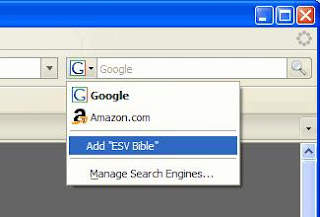
Another handy site to add to Search is Wikipedia.org. (Just be cautious about trusting Wikipedia articles; most are very good, but cross-check the information you find there against other sources.)
Here is how to use it:
Let's say you are working on something and want to use that reference to "the unfolding of your Word brings light," -- you know it's in Psalms or Proverbs, but don't have that memorized. Or you know it well but prefer to copy/paste it rather than typing it!
Click the down arrow on the search bar and select your Bible search page. Then fill in keywords or a reference (like James 3) in the search box. Press or click on the magnifying glass icon to start the search.
Voila! In a few seconds you have it:
"The unfolding of your words gives light;
it imparts understanding to the simple. (Psalm 119:30)"
This is very slick!
HT: Between Two Worlds
You can get Firefox (free) here. Firefox has many nice features, and feels faster than Internet Explorer. You can have more than one web browser on your PC or Mac at once.
Here is how to set up for searching (takes 1 minute):
1. Open Firefox 3
2. Navigate to a Bible search tool. Both of these work, there may be others you like:
BibleGateway
ESV Bible
3. Find the search bar, which will be on the upper right side of the brower. Click on the small down arrow at the left side of the search bar. Use your mouse to select BibleGateway or ESV. It will look like this:

Another handy site to add to Search is Wikipedia.org. (Just be cautious about trusting Wikipedia articles; most are very good, but cross-check the information you find there against other sources.)
Here is how to use it:
Let's say you are working on something and want to use that reference to "the unfolding of your Word brings light," -- you know it's in Psalms or Proverbs, but don't have that memorized. Or you know it well but prefer to copy/paste it rather than typing it!
Click the down arrow on the search bar and select your Bible search page. Then fill in keywords or a reference (like James 3) in the search box. Press
Voila! In a few seconds you have it:
"The unfolding of your words gives light;
it imparts understanding to the simple. (Psalm 119:30)"
This is very slick!
HT: Between Two Worlds
Thursday, January 15, 2009
Leaving Behind and Going Forward
Mark Batterson provides some good counsel on transitioning as you discern the will of God for you:
"I thought I'd share one of my litmus tests when it comes to discerning the will of God. I think the will of God is like a double-lock. You need to feel called to something. That's the first lock. But you also need to feel released from where you are or what you're doing. That is the second lock.
Here's where it gets complicated. Feeling called to and released from don't always happen simultaneously. In fact, they rarely do! If you feel called to something, but don't feel released from where you are, then you need to stay put. And God will honor your faithfulness! Where it gets even tougher, emotionally and spiritually, is when you feel released from something, but you don't know what God wants you to do next. It's like spiritual no-man's land. And that is when you need the courage to take a step of faith."
"I thought I'd share one of my litmus tests when it comes to discerning the will of God. I think the will of God is like a double-lock. You need to feel called to something. That's the first lock. But you also need to feel released from where you are or what you're doing. That is the second lock.
Here's where it gets complicated. Feeling called to and released from don't always happen simultaneously. In fact, they rarely do! If you feel called to something, but don't feel released from where you are, then you need to stay put. And God will honor your faithfulness! Where it gets even tougher, emotionally and spiritually, is when you feel released from something, but you don't know what God wants you to do next. It's like spiritual no-man's land. And that is when you need the courage to take a step of faith."
A Simple Way to Keep Up With Blogs
You're busy, and want to maximize the value of your time while staying informed, right? Then stop surfing through your list of favorite blogs and websites to see if there is something new. Subscribe to blogs in feed readers -- and then you'll be notified when there is new content. You'll save a TON of time and be a more efficient reader.
Surprisingly to me, only about 6% of blog readers do this. Let's increase that number!
If you use a feed reader, you can easily subscribe to this blog's content by clicking on the orange RSS icon in the address bar or on the side bar.
If you don’t use a reader, there is still a very easy way for you to keep up with this blog. You can subscribe by email. There is a form on the right side of this blog. Then, each morning the posts from the previous day will be delivered right to your inbox.
And if you don’t use an RSS reader but want to get started with one, Abraham Piper has a very helpful post on how to do that called What is RSS? A Step-by-Step Guide to Google Reader. He provides step by step instructions to seeting up this free tool. Recommended!
Surprisingly to me, only about 6% of blog readers do this. Let's increase that number!
If you use a feed reader, you can easily subscribe to this blog's content by clicking on the orange RSS icon in the address bar or on the side bar.
If you don’t use a reader, there is still a very easy way for you to keep up with this blog. You can subscribe by email. There is a form on the right side of this blog. Then, each morning the posts from the previous day will be delivered right to your inbox.
And if you don’t use an RSS reader but want to get started with one, Abraham Piper has a very helpful post on how to do that called What is RSS? A Step-by-Step Guide to Google Reader. He provides step by step instructions to seeting up this free tool. Recommended!
Wednesday, January 14, 2009
Faithy by Proxy? Check the Context
Matt Capps tackles the question about faith by proxy -- the idea that if the head of a household is saved, the whole family would be saved. He looks closely at Acts 11:14; 16:31 and other passages. There's a very nice description of how households actually worked in NT times. Plus you'll pick up some useful tips on interpreting Scripture.
Recommended.
Recommended.
Argue Like Jesus
This new book looks very interesting: How to Argue Like Jesus. I haven't read the book yet, but the free excerpt is very good (get it a their website), and I have great respect for Joe Carter based on his years of blogging at different sites.
Subscribe to:
Posts (Atom)

